Charles Darwin — The Voyage, the Idea, and the Book That Reshaped Science
From a five-year journey around the world to the theory of evolution by natural selection, this is the life of the naturalist who transformed biology forever.
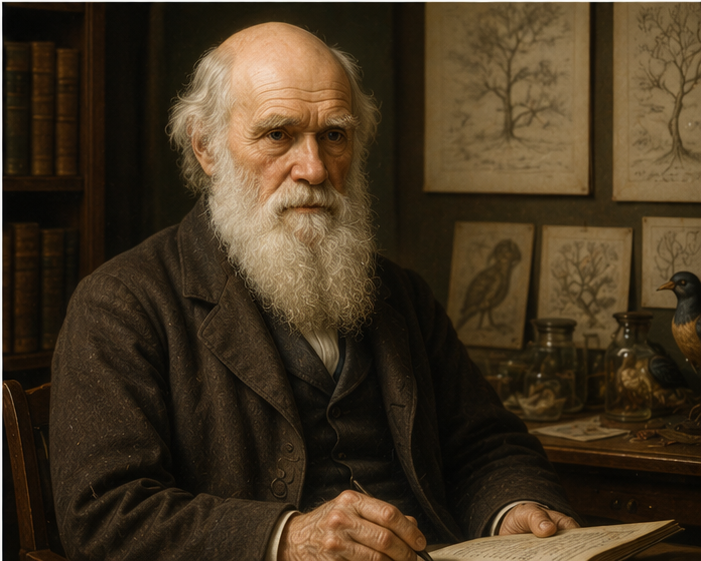
A quiet, careful observer of the natural world, Charles Darwin gathered evidence for decades before publishing an idea that would change science and society: that all living things are related through descent with modification, shaped by natural selection. This is the complete, verified timeline of his life and work.
Milestones
Charles Robert Darwin is born.
Darwin studies medicine.
Darwin studies at Christ's College, Cambridge.
A five-year journey around the world.
Darwin marries his cousin.
Darwin publishes on coral reefs.
Darwin is honored for his science.
Natural selection is announced.
Darwin publishes his landmark book.
Darwin extends his ideas to humans.
Darwin dies and is honored.
- February 12, 1809Birth in Shrewsbury
Charles Robert Darwin is born.
- 1825–1827Medical Studies at Edinburgh
Darwin studies medicine.
- 1828–1831Cambridge and Natural History
Darwin studies at Christ's College, Cambridge.
- 1831–1836The Voyage of HMS Beagle
A five-year journey around the world.
- January 29, 1839Marriage to Emma Wedgwood
Darwin marries his cousin.
- 1842Coral Reefs and Early Scientific Work
Darwin publishes on coral reefs.
- 1853The Royal Medal
Darwin is honored for his science.
- 1858The Joint Presentation with Wallace
Natural selection is announced.
- November 24, 1859"On the Origin of Species"
Darwin publishes his landmark book.
- 1871"The Descent of Man"
Darwin extends his ideas to humans.
- April 19, 1882Death and Burial at Westminster Abbey
Darwin dies and is honored.
Explore this story
Charles Darwin is one of the most influential figures in the history of science. His theory of evolution by natural selection provided a unifying explanation for the diversity of life on Earth and became a foundation of modern biology.
Born in England in 1809, Darwin trained first in medicine and then for the clergy before his true passion — natural history — led him aboard HMS Beagle for a voyage that would shape his life's work. His observations of plants, animals, and geology around the world, including the Galápagos Islands, planted the seeds of his revolutionary ideas.
Darwin worked cautiously, accumulating evidence for more than two decades before publishing "On the Origin of Species" in 1859. The book presented natural selection as the mechanism of evolution and sparked intense scientific and public debate that continues to shape discussions today.
This timeline traces Darwin's life from birth to death, with every major date and fact cross-checked against authoritative sources. Where interpretations differ, the material is presented neutrally.
- February 12, 1809Birth in Shrewsbury
Charles Robert Darwin is born.
Charles Darwin was born on February 12, 1809, in Shrewsbury, England, into a well-connected family. His grandfather Erasmus Darwin was a noted physician and natural philosopher.
The beginning of the life of one of science's most influential figures.
Darwin was born the same day as Abraham Lincoln.
- 1825–1827Medical Studies at Edinburgh
Darwin studies medicine.
Darwin studied medicine at the University of Edinburgh but found himself drawn away from medicine and toward natural history.
An early step that revealed his true scientific interests.
He reportedly found surgery of the era deeply distressing.
- 1828–1831Cambridge and Natural History
Darwin studies at Christ's College, Cambridge.
Darwin studied at Christ's College, University of Cambridge, initially intending to become a clergyman. There he deepened his interest in natural history and formed influential mentorships.
Prepared him intellectually for his life's work.
His enthusiasm for collecting beetles was well known.
- 1831–1836The Voyage of HMS Beagle
A five-year journey around the world.
From 1831 to 1836, Darwin served as naturalist aboard HMS Beagle. He observed plants, animals, fossils, and geology across South America, the Galápagos Islands, and beyond, gathering observations that would shape his theories.
The formative experience behind his evolutionary ideas.
His observations in the Galápagos, including variation among species, became especially significant.
- January 29, 1839Marriage to Emma Wedgwood
Darwin marries his cousin.
On January 29, 1839, Darwin married his first cousin, Emma Wedgwood. The couple would have ten children, several of whom died young.
Emma was a lifelong partner and support throughout his work.
Darwin famously drew up a list of pros and cons about marriage before proposing.
- 1842Coral Reefs and Early Scientific Work
Darwin publishes on coral reefs.
In 1842, Darwin published "The Structure and Distribution of Coral Reefs," an influential geological work that established part of his early scientific reputation.
Demonstrated his skill in geology, not only biology.
His theory of coral reef formation was largely confirmed by later science.
- 1853The Royal Medal
Darwin is honored for his science.
In 1853, Darwin was awarded the Royal Medal, recognizing his scientific contributions, including his work on geology and natural history.
Reflected his standing in the scientific community before his most famous work.
This recognition came years before "On the Origin of Species."
- 1858The Joint Presentation with Wallace
Natural selection is announced.
In 1858, the idea of evolution by natural selection was presented jointly on behalf of Darwin and Alfred Russel Wallace, who had independently developed similar ideas. This prompted Darwin to publish his own work.
Marked the formal scientific introduction of natural selection.
Wallace's independent work spurred Darwin to finally publish after years of delay.
— A Curious Young Naturalist (1809–1831)
Born in 1809 into a distinguished family, Darwin abandoned medical studies at Edinburgh and went to Cambridge intending to join the clergy. But his true passion was natural history — collecting, observing, and questioning the living world.
— The Voyage That Changed Everything (1831–1836)
As naturalist aboard HMS Beagle, Darwin spent five years observing the geology and biology of distant lands. The Galápagos Islands, with their striking variation among species, left a deep impression that would fuel his later theories.
— The Long Wait (1836–1858)
Back in England, Darwin married Emma Wedgwood in 1839, built a scientific reputation with works like his 1842 study of coral reefs, and earned the Royal Medal in 1853. All the while, he quietly developed his theory of natural selection — hesitant to publish. Alfred Russel Wallace's independent discovery finally prompted the 1858 joint presentation.
— The Book and the Legacy (1859–1882)
In 1859, Darwin published "On the Origin of Species," transforming science. He later extended his ideas to humans in "The Descent of Man." When he died in 1882, he was buried at Westminster Abbey — a fitting honor for a man whose ideas reshaped our understanding of life.
- Darwin was born on February 12, 1809 — the same day as Abraham Lincoln.
- He first studied medicine but disliked it.
- He went to Cambridge intending to become a clergyman.
- He sailed aboard HMS Beagle for about five years.
- His Galápagos observations were pivotal to his theory.
- He married his first cousin, Emma Wedgwood.
- He had ten children.
- He famously listed pros and cons before deciding to marry.
- Darwin's full name was Charles Robert Darwin.
- He initially studied medicine at Edinburgh before switching paths.
- At Cambridge he was known for his passion for collecting beetles.
- His grandfather Erasmus Darwin had written about ideas related to life's change over time.
- The Beagle voyage lasted roughly five years.
- Darwin suffered from ill health for much of his later life.
- He lived at Down House in Kent, where he did much of his work.
- His 1842 coral reef theory addressed how atolls form.
Darwin invented the idea of evolution alone
Others explored related ideas; Darwin provided a compelling mechanism (natural selection) with strong evidence, alongside Wallace's independent work.
Darwin said humans descended from monkeys
His work indicated humans and other primates share common ancestors, not that humans descended from modern monkeys.
Darwin published his theory immediately
He worked for over two decades before publishing.
Darwin was a lone genius with no rivals
Alfred Russel Wallace independently reached similar conclusions.
Darwin only studied animals
He also made major contributions to geology.
"On the Origin of Species" covered human evolution in detail
Human evolution was addressed more fully later in "The Descent of Man."
Darwin was ignored in his lifetime
He was widely recognized and honored.
The Galápagos alone gave him the theory
Many observations over years contributed; the Galápagos were especially influential.
Darwin coined the phrase "survival of the fittest."
That phrase is associated with Herbert Spencer and was later adopted into discussions of his theory.
Darwin's ideas are scientifically outdated
Evolution remains a foundation of modern biology, refined by later discoveries.
Note: Only responsibly attributable ideas are included; exact verbatim quotations are omitted where wording could not be verified against authoritative sources.
Darwin's central idea — that species change over time through descent with modification, shaped by natural selection — is the core message of "On the Origin of Species."
Darwin is widely associated with the theme that life's diversity arises from gradual change over immense periods of time.
Charles Darwin's legacy is foundational to modern science. His theory of evolution by natural selection unified biology and transformed how humanity understands its own place in nature. His careful, evidence-based approach set a standard for scientific inquiry, and his work continues to influence fields from genetics to ecology to medicine.
Darwin's influence extends across the sciences and beyond. Evolutionary theory reshaped biology, informed the development of genetics, and influenced fields as varied as anthropology, psychology, and philosophy. His ideas remain central to scientific education and to ongoing discussions about life, adaptation, and the natural world.
- Did you know Darwin was born the same day as Abraham Lincoln?
- Did you know he first studied medicine?
- Did you know he went to Cambridge to become a clergyman?
- Did you know he sailed on HMS Beagle for about five years?
- Did you know his Galápagos observations were pivotal?
- Did you know he married his first cousin, Emma Wedgwood?
- Did you know he had ten children?
- Did you know he listed pros and cons before deciding to marry?
Darwin vs. Wallace: Both independently developed natural selection; Darwin is best known for the extensive evidence and the landmark book. Darwin vs. Mendel: Darwin explained how species change through natural selection; Mendel later revealed the mechanisms of inheritance, and the two ideas were combined by later scientists. Early Darwin vs. later Darwin: The young naturalist gathered observations aboard the Beagle; the mature scientist synthesized decades of evidence into a unifying theory. Darwin vs. earlier thinkers: Where earlier thinkers speculated about change in life, Darwin provided a testable mechanism supported by extensive evidence.
Darwin's work changed the course of science and human thought. By explaining the diversity of life through natural selection, he provided a unifying framework for biology and reshaped humanity's understanding of its origins. His influence reaches into genetics, medicine, ecology, and beyond, making him one of the most consequential scientists in history.
"On the Origin of Species" by Charles Darwin.
"The Voyage of the Beagle" by Charles Darwin.
"The Descent of Man" by Charles Darwin.
"Darwin: The Life of a Tormented Evolutionist" by Adrian Desmond and James Moore.
- Documentaries on Darwin, evolution, and the voyage of HMS Beagle produced by major science and nature broadcasters.
- Educational programs on the history of evolutionary biology. (Specific titles omitted where accurate details could not be verified.)
1809 born → 1825–1827 medicine at Edinburgh → 1828–1831 Cambridge → 1831–1836 HMS Beagle voyage → 1839 marries Emma Wedgwood → 1842 coral reefs book → 1853 Royal Medal → 1858 joint presentation with Wallace → 1859 "On the Origin of Species" → 1871 "The Descent of Man" → 1882 dies and is buried at Westminster Abbey.
- Turning from medicine toward natural history.
- The decision to join the HMS Beagle voyage.
- Observations in the Galápagos Islands.
- Marriage to Emma Wedgwood in 1839.
- Building a scientific reputation with the 1842 coral reefs work.
- Receiving the Royal Medal in 1853.
- Wallace's independent discovery prompting the 1858 presentation.
- Publishing "On the Origin of Species" in 1859.
- Extending his ideas in "The Descent of Man."
- His burial at Westminster Abbey in 1882.
Darwin's theory of evolution by natural selection generated significant scientific and public debate, particularly regarding its implications for the origins of humanity. These debates involved religious, philosophical, and scientific perspectives. This timeline presents Darwin's ideas and their reception neutrally, as a matter of historical record; evolution is today a foundational and widely accepted scientific theory, while discussions about its broader implications continue in various contexts.
Darwin received major scientific honors during his lifetime, including the Royal Medal (1853) and other distinctions from leading scientific institutions. His burial at Westminster Abbey was itself a profound recognition of his importance. He is remembered as one of the most honored and influential scientists in history. (Some individual honors are summarized generally where exact details could not be independently verified.)
Charles Darwin remains one of the most famous scientists in the world. His name is instantly associated with evolution, his books are still widely read, and his image appears in classrooms, museums, and popular culture. Darwin Day, marked on his birthday, celebrates his contributions to science each year.
As of 2026, Darwin's work remains foundational to biology and to our understanding of life. Evolutionary theory underpins advances in medicine, genetics, conservation, and beyond. His example of patient, evidence-based inquiry continues to inspire scientists, and his ideas remain essential to how we understand the natural world and our place within it.
1. When was Charles Darwin born?
2. Where was Darwin born?
3. What ship did Darwin sail on?
- 1809: Born in Shrewsbury.
- 1831–1836: Voyage of HMS Beagle.
- 1839: Marries Emma Wedgwood.
- 1858: Natural selection presented jointly with Wallace.
- 1859: "On the Origin of Species" published.
- 1882: Dies and is buried at Westminster Abbey.
SHORT SUMMARY: Charles Darwin (1809–1882) developed the theory of evolution by natural selection, drawing on his five-year voyage aboard HMS Beagle, and published "On the Origin of Species" in 1859 — transforming biology forever.
MEDIUM SUMMARY: Born in Shrewsbury in 1809, Darwin abandoned medicine and studied at Cambridge before sailing on HMS Beagle from 1831 to 1836. His observations, especially in the Galápagos, shaped his theory of natural selection. He married Emma Wedgwood in 1839, built a scientific reputation, and — spurred by Alfred Russel Wallace's independent work — presented natural selection in 1858 and published "On the Origin of Species" in 1859. He later wrote "The Descent of Man," and was buried at Westminster Abbey upon his death in 1882.
LONG SUMMARY: Charles Robert Darwin, born February 12, 1809 in Shrewsbury, England, became one of the most influential scientists in history. After leaving medical studies at Edinburgh, he attended Christ's College, Cambridge, intending to enter the clergy, but his passion for natural history prevailed. From 1831 to 1836 he served as naturalist aboard HMS Beagle, observing geology and wildlife across the globe; the variation among species in the Galápagos Islands proved especially influential. He married his cousin Emma Wedgwood in 1839, and together they had ten children, several of whom died young. Darwin established his scientific reputation with works such as "The Structure and Distribution of Coral Reefs" (1842) and received the Royal Medal in 1853. Working cautiously for more than two decades, he was finally prompted to publish when Alfred Russel Wallace independently arrived at the idea of natural selection, leading to a joint presentation in 1858. In 1859, Darwin published "On the Origin of Species," presenting evolution by natural selection with extensive evidence and igniting a debate that reshaped science and society. He later extended his ideas to human origins in "The Descent of Man." Darwin died on April 19, 1882, at Down House in Kent, and was buried at Westminster Abbey — a lasting tribute to a man whose ideas became a foundation of modern biology.
- 1.Britannica — Charles Darwin biography (birth, education, Beagle voyage, major works, death).
- 2.Westminster Abbey — official page on Charles Darwin (burial and life details).
- 3.Darwin Correspondence Project (University of Cambridge) — biographical and dating details.
- 4.Natural History Museum (London) — materials on Darwin, the Beagle voyage, and evolution.
- 5.Reference material on "On the Origin of Species" (published November 24, 1859) and the 1858 Darwin–Wallace presentation.
Related timelines
The brilliant, eccentric inventor whose alternating-current system lit up cities - and who dreamed of wireless power decades ahead of his time.
A poor girl from occupied Poland who became the first person in history to win two Nobel Prizes - and paid for her discoveries with her life.
How a patent clerk in Bern reimagined space, time, light and gravity - and became the most famous scientist who ever lived.
The mathematician who imagined the modern computer, cracked Nazi codes, and was persecuted for who he was - only to be honored decades too late.
How a solitary genius uncovered the laws of motion and gravity, invented a new mathematics, and laid the foundations of modern science.