ALAN TURING
The mathematician who imagined the modern computer, cracked Nazi codes, and was persecuted for who he was - only to be honored decades too late.
He conceived the idea of the universal computing machine, broke the codes that helped defeat Nazi Germany, and then was destroyed by the very country he had saved.
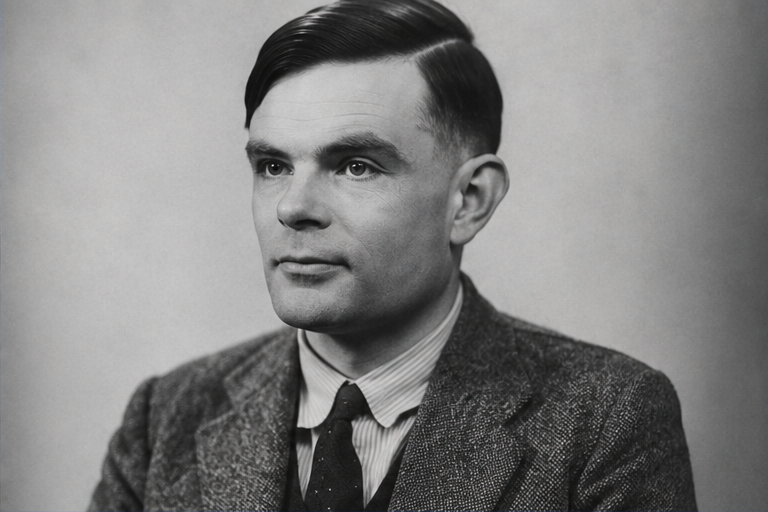
Alan Mathison Turing (1912-1954) was an English mathematician, logician, and computer scientist widely regarded as the father of theoretical computer science and artificial intelligence. He formalized the concepts of algorithm and computation with the "Turing machine," a model of a general-purpose computer. During World War II he played a crucial role in breaking German codes at Bletchley Park. He proposed the "Turing test" for machine intelligence. Convicted in 1952 under laws that criminalized homosexuality, he died in 1954, and received a royal pardon only in 2013.
Explore this story
Alan Turing asked a question that changed the world: what does it mean for a machine to compute?
A brilliant, unconventional mathematician, Turing imagined a simple, abstract device - now called the Turing machine - that could, in principle, carry out any calculation. In doing so he defined the very idea of computation and laid the theoretical foundation for every computer that followed.
When World War II broke out, Turing put his genius to urgent use at Britain's secret codebreaking center, Bletchley Park. There he helped crack the German Enigma cipher, work that is widely credited with shortening the war and saving countless lives. After the war, he helped design early computers and boldly asked whether machines could think, proposing a famous test that still frames debates about artificial intelligence.
Yet Turing's story is also a tragedy. Prosecuted for being gay at a time when it was a crime, he was subjected to a punishing treatment and died in 1954. Decades later, Britain issued an official apology and a royal pardon. This is the story of a genius who shaped the modern world and was failed by it.
- 23 June 1912Birth in London
Alan Mathison Turing is born in London.
Turing was born in 1912 in London, the second son of Julius and Ethel Turing. His father served in the Indian Civil Service, and Alan and his brother were raised largely in England.
His early brilliance in mathematics and science emerged despite a conventional schooling that did not always suit him.
As a boy he showed an intense, independent curiosity that teachers found both remarkable and difficult.
- 1931-1934Studies at Cambridge
Turing studies mathematics at King's College, Cambridge.
Turing studied mathematics at King's College, University of Cambridge, graduating with distinction and later being elected a fellow.
Cambridge nurtured the logical genius that would soon reshape mathematics and computing.
He was elected a fellow of King's College at just 22.
- 1936The Turing machine
Turing publishes his groundbreaking idea of a universal computing machine.
In a landmark 1936 paper, Turing described an abstract machine that could perform any computation that follows a set of rules. This "Turing machine" formalized the concepts of algorithm and computation.
It laid the theoretical foundation for all modern computers.
The paper addressed a deep problem in mathematical logic while inventing the concept of the general-purpose computer almost as a byproduct.
- 1936-1938Doctorate at Princeton
Turing earns a PhD in the United States.
Turing pursued advanced study at Princeton University, earning his doctorate and deepening his work in logic and computation.
His time in America broadened his mathematical influence and connections.
He returned to England shortly before the outbreak of World War II.
- 1939-1945Codebreaking at Bletchley Park
Turing leads crucial work breaking German codes during the war.
During World War II, Turing worked at Bletchley Park, Britain's secret codebreaking center. He was central to cracking the German Enigma cipher and helped design the "Bombe," an electromechanical machine that sped up the breaking of Enigma settings.
The intelligence gained is widely credited with helping shorten the war and save many lives.
He also devised methods to break an even more complex German cipher system known as "Tunny."
- 1945-1948Designing early computers
Turing works on pioneering stored-program computer designs.
After the war, Turing worked at the National Physical Laboratory on the design of the Automatic Computing Engine (ACE), one of the first detailed designs for a stored-program computer, and later moved to work on computing at the University of Manchester.
His designs helped bridge his theoretical ideas and real, working computers.
The ACE design was remarkably advanced for its time.
- 1950The Turing test
Turing proposes a test for machine intelligence.
In a 1950 paper, Turing asked whether machines could think and proposed what became known as the "Turing test": if a machine could converse indistinguishably from a human, it could be considered intelligent.
The idea became a cornerstone of the field of artificial intelligence.
The paper opened with the provocative question, "Can machines think?"
- 1952Mathematical biology
Turing publishes influential work on patterns in nature.
In 1952 Turing published pioneering work on morphogenesis - how patterns such as spots and stripes form in living organisms - applying mathematics to biology.
It founded a field of mathematical biology still studied today.
His theory anticipated ideas confirmed by biologists decades later.
An Unconventional Genius
Alan Turing was born in London in 1912 and showed an early, intense gift for mathematics and science, even when conventional schooling struggled to contain him. His independent mind set him apart from childhood.
Inventing the Idea of the Computer
At Cambridge and then Princeton, Turing tackled deep problems in logic. In 1936 he described an abstract "Turing machine" that could carry out any computation. In defining what computation itself meant, he laid the theoretical foundation for the modern computer.
The Codebreaker
When war came, Turing joined the secret effort at Bletchley Park. His work breaking the German Enigma cipher, aided by the Bombe machine he helped design, gave the Allies priceless intelligence and is widely credited with helping shorten the war.
Machines That Think
After the war, Turing helped design some of the earliest computers and turned to a bold new question: could machines think? His 1950 Turing test became a founding idea of artificial intelligence, and his later work even applied mathematics to patterns in living things.
Persecution
In 1952, Turing was convicted of "gross indecency" simply for being gay. He was subjected to hormone treatment and stripped of his security clearance. Two years later he was dead, at just 41 - a devastating loss.
Recognition, Too Late
Decades later, Britain confronted the injustice done to Turing. An official apology in 2009 was followed by a royal pardon in 2013, a law pardoning others in 2017, and his image on the 50-pound note. Today he is honored worldwide as a founder of the computer age.
- He invented the concept of the general-purpose computer in 1936.
- He is considered the father of theoretical computer science.
- He helped break the German Enigma cipher in World War II.
- His codebreaking is credited with helping shorten the war.
- He helped design the Bombe machine.
- He proposed the Turing test for machine intelligence.
- He earned a doctorate at Princeton University.
- He was elected a fellow of King's College, Cambridge, at 22.
- He was a near-Olympic-standard marathon runner.
- His 1936 paper was primarily about a deep problem in mathematical logic.
- He spent time studying at Princeton before the war.
- He worked on speech encryption systems as well as codebreaking.
- His wartime achievements were classified for many years.
- He helped design the advanced ACE computer.
- He contributed to early work at the University of Manchester's computing lab.
- His work on morphogenesis was ahead of its time.
Turing personally built the first computer.
He defined computation theoretically and contributed to early designs; building working computers involved many people.
Turing single-handedly broke Enigma.
He was central to a large team effort at Bletchley Park, aided by earlier Polish work and the Bombe machine.
The Turing test proves a machine is conscious.
It tests whether a machine can imitate human conversation, not whether it truly "thinks" or is conscious.
Turing's genius was recognized in his lifetime.
Much of his most important work was secret; full recognition came largely after his death.
Turing's death is a settled
The suicide ruling is debated, with some arguing accidental poisoning is possible.
Turing only worked on computers.
He also did pioneering work in logic and mathematical biology.
The pardon fixed everything.
The pardon was symbolic recognition; it could not undo the injustice he suffered.
Turing was a poor communicator with no other talents.
He was, among other things, a world-class distance runner.
Enigma was unbreakable until Turing alone solved it.
Breaking Enigma built on prior work and teamwork; Turing's contributions were crucial but not solitary.
Turing's ideas are only historical.
His concepts remain foundational to computing and AI today.
Note: The following are widely attributed to Turing, chiefly from his published writing; wording is quoted or summarized carefully.
Quote 1: Turing opened his 1950 paper by proposing to consider the question, "Can machines think?"
Meaning: He reframed a philosophical puzzle into a concrete, testable question about machine behavior.
Quote 2: He is widely quoted as saying that sometimes it is the people no one imagines anything of who do the things no one can imagine.
Meaning: The sentiment - popularized in retellings of his life - captures how an unconventional outsider changed the world. (Its exact origin is debated, so it is best treated as associated with his story rather than a verified original quotation.)
Quote 3: In his scientific writing he emphasized building machines that could learn and improve.
Meaning: He anticipated the core idea behind modern machine learning.
Turing's legacy is foundational to the digital world. His theoretical work defined what computers can do, his wartime codebreaking helped change the course of history, and his questions about machine intelligence launched the field of artificial intelligence. He is also remembered as a symbol of the injustice of anti-gay laws, and his rehabilitation helped prompt broader recognition of past wrongs.
Turing influenced computer science, cryptography, artificial intelligence, and even biology. Every general-purpose computer is, in a sense, a realization of his ideas. His name marks a top computing award and countless concepts, and his life shaped public conversations about civil rights and historical justice.
- Did you know Turing imagined the modern computer back in 1936?
- Did you know he helped break the Nazi Enigma code?
- Did you know his work is credited with shortening World War II?
- Did you know he proposed the famous Turing test?
- Did you know he earned a PhD at Princeton?
- Did you know he was a fellow of King's College at 22?
- Did you know he was a world-class marathon runner?
- Did you know he pioneered the math of patterns in nature?
Turing vs Charles Babbage: Babbage designed early mechanical calculating engines; Turing defined the theory of universal computation that underlies modern computers.
Turing vs John von Neumann: Both shaped computing; Turing provided key theoretical foundations, while von Neumann is associated with the architecture of practical stored-program computers.
Turing vs Claude Shannon: Shannon founded information theory; Turing founded the theory of computation - together underpinning the digital age.
Turing vs Albert Einstein: Both were transformative 20th-century thinkers; Einstein reshaped physics, Turing reshaped computing and the idea of intelligence.
- Science & Technology
- Founded theoretical computer science and shaped artificial intelligence.
- Military History
- His codebreaking helped the Allies and is credited with shortening World War II.
- Mathematics
- Solved a deep problem in logic and created the theory of computation.
- Biology
- Pioneered mathematical models of biological pattern formation.
- Society
- Became a symbol of the injustice of anti-gay laws and their eventual repudiation.
- Culture
- Inspired films, plays, and books that brought his story to millions.
- Education
- His concepts are core to computer science curricula worldwide.
- Legacy
- Lends his name to a premier computing prize and countless ideas.
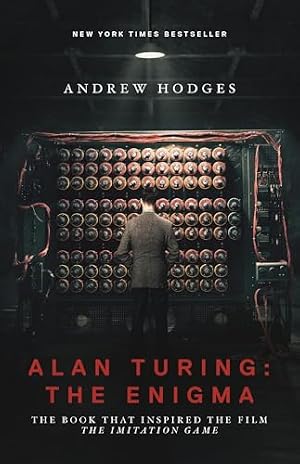
Alan Turing: The Enigma
by Andrew Hodges

Alan M. Turing
by Sara Turing
As an Amazon Associate, TimelineSphere earns from qualifying purchases.
- The life and work of Alan Turing.
- Codebreaking at Bletchley Park.
- The breaking of the Enigma cipher.
- The origins of artificial intelligence.
- The campaign to pardon Alan Turing.
1912 born in London; 1931-1934 studies at Cambridge; 1936 publishes the Turing machine paper; 1936-1938 earns a doctorate at Princeton; 1939-1945 breaks codes at Bletchley Park; 1945-1948 works on early computer designs; 1950 proposes the Turing test; 1952 publishes work on morphogenesis and is convicted of gross indecency; 1954 dies of cyanide poisoning; 2009 official apology; 2013 royal pardon; 2017 Turing law; 2021 featured on the 50-pound note.
- Election as a fellow of King's College, Cambridge.
- Publishing the Turing machine paper in 1936.
- Joining Bletchley Park in 1939.
- Helping break the Enigma cipher.
- Designing the Bombe machine.
- Working on early stored-program computers.
- Proposing the Turing test in 1950.
- His 1952 conviction and treatment.
- His death in 1954.
- His posthumous pardon in 2013.
- His persecution: his 1952 conviction and treatment are now widely condemned as a grave injustice.
- Cause of death: whether his death was suicide or accidental remains debated.
- Credit for codebreaking: popular accounts sometimes overstate his solo role, downplaying the wider team and earlier Polish work.
- Secrecy and recognition: the long classification of his war work delayed proper acknowledgment of his contributions.
- Officer of the Order of the British Empire (OBE) for his wartime service.
- Fellow of the Royal Society (elected 1951).
- Posthumous honors, including the naming of the Turing Award, computing's most prestigious prize, in his memory.
Turing is celebrated worldwide, and especially in Britain, as a scientific hero and a symbol of justice. He is widely known among students of computing and the general public alike, his fame amplified by films, books, and his appearance on British currency.
Turing's ideas underpin every computer and smartphone, and his questions about machine intelligence are more relevant than ever amid the rise of artificial intelligence. His life is also a powerful reminder of the human cost of injustice and the importance of recognizing and correcting it.
1. In what year was Alan Turing born?
2. What abstract device is named after Turing?
3. Where did Turing work during World War II?
Did You Know: Alan Turing imagined the concept of the modern computer years before any such machine existed.
Imagine If: Imagine if Turing's team had failed to break Enigma - the course of World War II might have been very different.
Historic Moment: In 1950, Turing asked "Can machines think?" - launching the field of artificial intelligence.
On This Day: On 7 June 1954, Alan Turing died at just 41, decades before his country would honor him.
Alan Turing (1912-1954) was an English mathematician who invented the concept of the computer, helped break Nazi codes in World War II, and founded ideas in artificial intelligence, before being persecuted for being gay.
Turing introduced the Turing machine in 1936, defining computation and laying the foundation for modern computers. At Bletchley Park during World War II, he was central to breaking the Enigma cipher. He proposed the Turing test for machine intelligence and worked on early computers. Convicted in 1952 for homosexual acts, he died in 1954 and received a royal pardon in 2013.
Alan Mathison Turing was born in London in 1912 and studied mathematics at Cambridge before earning a doctorate at Princeton. In 1936 he described the Turing machine, formalizing the idea of computation and laying the theoretical foundation for the modern computer. During World War II he worked at Bletchley Park, where he was central to breaking the German Enigma cipher and helped design the Bombe machine, work credited with helping shorten the war. Afterward he contributed to early computer designs, proposed the Turing test for machine intelligence in 1950, and pioneered mathematical biology. In 1952 he was convicted of gross indecency for homosexual acts and subjected to hormone treatment. He died of cyanide poisoning in 1954 at age 41. Britain issued an official apology in 2009, a royal pardon in 2013, and a law pardoning others in 2017, and honored him on the 50-pound note in 2021.
People searching "Alan Turing" typically want: a biography and timeline; what he invented; how he helped break Enigma; what the Turing test is; why he was convicted; when and how he was pardoned; and his lasting influence on computing and AI.
- 1.Encyclopaedia Britannica - "Alan Turing" (life, Turing machine, Bombe, Turing test, conviction).
- 2.Wikipedia's sourced summary and the biography "Alan Turing: The Enigma" by Andrew Hodges (birth, career, death, pardon).
- 3.HISTORY - "Alan Turing: Biography, Code Breaking, Computer & Death."
- 4.New Scientist - key biographical facts (birth in London, death in Wilmslow).
- 5.BBC News and UK Parliament records - the 1952 conviction, 2009 apology, 2013 royal pardon, and 2017 Turing law.
- 6.NIST - overview of Turing's contributions to computing, AI, and cryptography.
Related timelines
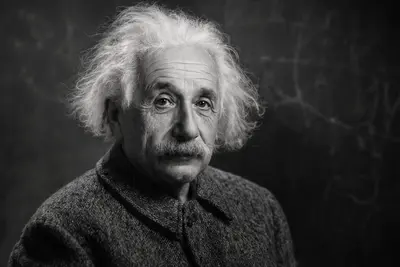
How a patent clerk in Bern reimagined space, time, light and gravity - and became the most famous scientist who ever lived.
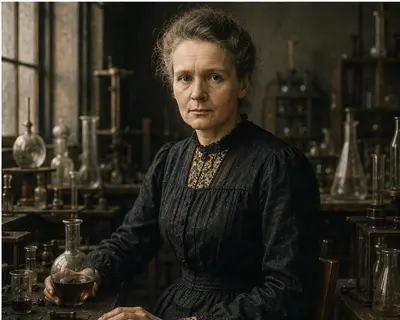
A poor girl from occupied Poland who became the first person in history to win two Nobel Prizes - and paid for her discoveries with her life.
The brilliant, eccentric inventor whose alternating-current system lit up cities - and who dreamed of wireless power decades ahead of his time.
From a five-year journey around the world to the theory of evolution by natural selection, this is the life of the naturalist who transformed biology forever.
How a solitary genius uncovered the laws of motion and gravity, invented a new mathematics, and laid the foundations of modern science.

How two Stanford students in a rented garage built the company that became the front door to the internet.