NIKOLA TESLA
The brilliant, eccentric inventor whose alternating-current system lit up cities - and who dreamed of wireless power decades ahead of his time.
He imagined a world powered by invisible currents and wireless energy, won the war to electrify America, and then died nearly forgotten and penniless in a New York hotel room.
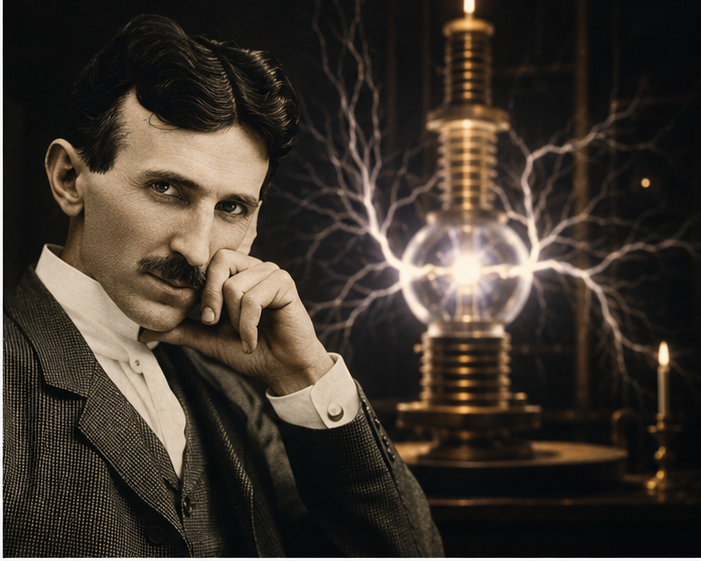
Nikola Tesla (1856-1943) was a Serbian-American engineer and inventor whose work formed the basis of modern alternating-current (AC) electricity. He discovered the rotating magnetic field, developed the AC induction motor and polyphase power system, and sold his key patents to George Westinghouse. He pioneered work in wireless communication and power, high-frequency devices, and the famous Tesla coil. Brilliant but financially unlucky, he died in relative obscurity, only to become a legendary figure long after his death.
Explore this story
Nikola Tesla saw the future in flashes of electricity.
Born during a lightning storm in a small village in the Austrian Empire, Tesla grew into one of the most imaginative inventors who ever lived. He pictured entire machines in his mind before building them, and he became convinced that the world should be powered by alternating current - a technology many, including Thomas Edison, opposed.
Tesla was right. His rotating magnetic field and AC induction motor, backed by industrialist George Westinghouse, won the "war of the currents" and became the foundation of the electrical grids that light cities today. He went on to explore wireless communication and the transmission of power without wires, ideas far ahead of his era.
Yet for all his genius, Tesla struggled with money and business. His grand dream of wireless global power collapsed when his funding was cut, and he spent his final years alone, feeding pigeons and living on credit. Only after his death did the world fully embrace him as a visionary. This is his story.
- 9-10 July 1856Birth in Smiljan
Nikola Tesla is born in the village of Smiljan.
Tesla was born on the night between 9 and 10 July 1856 (officially recorded as 10 July) in Smiljan, then part of the Austrian Empire and now in Croatia. He came from a Serbian family; his father was an Orthodox priest and his mother an inventive homemaker.
His gifted family environment nurtured a remarkable imagination.
According to legend, he was born during a fierce lightning storm.
- 1870sEducation and early fascination
Tesla studies engineering and becomes fascinated by electricity.
Tesla attended the Graz University of Technology, where he became deeply interested in alternating current, though he ultimately left without a degree.
His student-era insights into AC would shape his life's work.
He was expected to enter the priesthood like his father but chose engineering instead.
- 1884Emigration to America
Tesla arrives in the United States to work in electrical engineering.
In 1884 Tesla emigrated to the United States, where he briefly worked for Thomas Edison's organization before the two parted ways.
America became the stage for his greatest achievements.
He reportedly arrived with very little money and a letter of introduction to Edison.
- 1887-1888The AC induction motor
Tesla develops the rotating magnetic field and AC induction motor.
Tesla discovered the rotating magnetic field and, in 1888, patented the first practical alternating-current induction motor, along with a polyphase system for transmitting AC power.
These inventions became the foundation of modern electrical power.
The rotating magnetic field is still central to most AC machinery today.
- 1888Partnership with Westinghouse
George Westinghouse licenses Tesla's AC patents.
In 1888 industrialist George Westinghouse licensed Tesla's motor and power patents, enabling the Westinghouse company to build a serious alternating-current system to rival Edison's direct current.
The alliance set the stage for the triumph of AC power.
The deal made Tesla's technology the backbone of a major electrical company.
- Late 1880s-1890sThe war of the currents
AC and DC systems compete to electrify America.
Tesla and Westinghouse's alternating-current system competed against Thomas Edison's direct-current system. AC's ability to transmit power efficiently over long distances gave it a decisive advantage.
The outcome shaped the design of electrical grids worldwide.
The rivalry became a fierce and sometimes bitter public battle.
- 1891The Tesla coil and citizenship
Tesla invents the Tesla coil and becomes an American citizen.
In 1891 Tesla invented the Tesla coil, a high-voltage, high-frequency transformer that became important for radio and experimentation. He also became a naturalized U.S. citizen.
The Tesla coil advanced high-frequency electrical research.
Tesla said he valued his citizenship papers more than his many honors.
- 1893Showcasing AC power
The AC system is displayed prominently at a world's fair.
Tesla and Westinghouse's alternating-current system was showcased by lighting a major world's fair, demonstrating AC's power and safety to a huge public audience.
The demonstration helped win public confidence in AC.
The spectacle dazzled millions of visitors.
The Boy Born in a Storm
Nikola Tesla was born in 1856 in a small village in the Austrian Empire, the son of a Serbian Orthodox priest. A brilliant, imaginative child with an extraordinary memory, he was expected to join the priesthood but was drawn instead to the mysteries of electricity and machines.
A Dream of Alternating Current
As a student, Tesla became obsessed with the idea of harnessing alternating current, which experts told him was impractical. He carried the vision of a rotating magnetic field in his head for years before he could build it - a vision that would eventually electrify the world.
America and Edison
In 1884 Tesla arrived in the United States and briefly worked for Thomas Edison. The two very different men soon parted. Tesla struck out on his own, and by 1888 he had patented the AC induction motor and a polyphase power system.
Winning the War of the Currents
George Westinghouse licensed Tesla's patents, and their alternating-current system challenged Edison's direct current. AC's ability to travel long distances efficiently won the day, dramatically demonstrated at a great world's fair and cemented by the harnessing of Niagara Falls.
Reaching Too Far
Tesla dreamed bigger still - of transmitting information and power wirelessly around the globe. His Wardenclyffe Tower project, backed briefly by J.P. Morgan, collapsed when the money ran out. It was a blow from which his finances never recovered.
Obscurity and Immortality
Tesla spent his final decades increasingly isolated, brilliant but broke, and died alone in a New York hotel in 1943. Yet his reputation only grew after his death. Today he is celebrated as one of history's great visionaries, and the unit of magnetic flux density bears his name.
- Legend says Tesla was born during a lightning storm.
- His father was a Serbian Orthodox priest.
- He was expected to become a priest but chose engineering.
- He carried the idea of the rotating magnetic field in his mind for years.
- He emigrated to America in 1884 with almost no money.
- He briefly worked for Thomas Edison.
- He patented the first practical AC induction motor in 1888.
- He developed the polyphase power system.
- He studied at the Graz University of Technology but left without a degree.
- He worked in Europe on early telephone and electrical projects before emigrating.
- He had a photographic memory and vivid mental imagery.
- He had many well-documented personal quirks and routines.
- He often struggled to translate his genius into business success.
- He gave up lucrative royalty terms with Westinghouse during a company crisis, by many accounts.
- His demonstrations of high-frequency currents drew fascinated crowds.
- He envisioned global wireless communication long before it existed.
Tesla invented electricity.
Electricity was studied long before him; Tesla developed the AC systems that made large-scale power practical.
Tesla single-handedly invented radio.
Radio had many contributors; a 1943 Supreme Court decision recognized some of Tesla's key patents.
Edison and Tesla were simple enemies.
They were rivals with different approaches, but the story is more nuanced than pure enmity.
Tesla's ideas all worked.
Some, like global wireless power, were never realized.
Tesla founded the modern car company that bears his name.
The company was named in his honor but has no direct connection to him.
Tesla died famous and rich.
He died in relative poverty and only became widely celebrated later.
Tesla had no recognition in his lifetime.
He received honors such as the Edison Medal, though full appreciation came later.
Every dramatic claim about Tesla is true.
Some late-life claims are unverified, and legends have grown around him.
AC won purely because of Tesla alone.
Westinghouse's backing and the technology's long-distance efficiency were crucial.
Tesla was purely a lone genius.
He collaborated with and depended on industrialists, engineers, and financiers.
Note: The following are widely attributed to Tesla; wording varies across sources, so meanings are summarized.
Quote 1: Tesla is often quoted as saying that the present is theirs, but the future, for which he really worked, was his.
Meaning: He believed his ideas would be vindicated by later generations, even if unappreciated in his time.
Quote 2: He spoke of the value of nature and energy, expressing fascination with harnessing the forces of the natural world.
Meaning: His work aimed to capture and distribute the vast energy around us.
Quote 3: He emphasized the power of the imagination and mental visualization in invention.
Meaning: Tesla credited his ability to design complete machines in his mind as central to his genius.
Tesla's legacy is immense and grew dramatically after his death. His alternating-current system underpins the electrical grids that power the modern world. His pioneering ideas in wireless technology anticipated developments that arrived decades later. Today he is honored with the SI unit the tesla, museums, and a lasting reputation as one of the most imaginative inventors in history.
Tesla influenced electrical engineering, power distribution, and radio technology. His vision of wireless communication and energy inspired later inventors and continues to fuel the popular imagination. His life also shaped the archetype of the brilliant, unappreciated genius.
- Did you know Tesla was reportedly born during a lightning storm?
- Did you know his father was a priest?
- Did you know he briefly worked for Edison?
- Did you know he patented the AC induction motor in 1888?
- Did you know Westinghouse licensed his patents?
- Did you know his AC system won the war of the currents?
- Did you know his designs helped power Niagara Falls?
- Did you know he invented the Tesla coil in 1891?
Tesla vs Edison: Edison championed direct current and was a shrewd businessman; Tesla championed alternating current and was a visionary inventor less focused on profit.
Tesla vs Marconi: Both contributed to radio; Marconi achieved early fame for transmissions, but a 1943 court decision recognized key Tesla patents.
Tesla vs Westinghouse: Tesla provided the inventions; Westinghouse provided the business power to bring AC to the world.
Tesla vs Einstein: Both are icons of genius; Tesla was a practical inventor of electrical technology, Einstein a theoretical physicist.
- Science & Technology
- Established the foundations of AC power and advanced high-frequency and wireless research.
- Industry
- Enabled long-distance electric power transmission and modern grids.
- Economy
- Helped make widespread, affordable electrification possible.
- Culture
- Became a symbol of visionary, misunderstood genius.
- Radio
- Contributed foundational patents to early wireless communication.
- Energy
- Shaped how the world generates and distributes electricity.
- Society
- Helped bring electric light and power to everyday life.
- Legacy
- Inspired later inventors and popular fascination with his ideas.
Tesla: Man Out of Time
by Margaret Cheney
Wizard: The Life and Times of Nikola Tesla
by Marc J. Seifer
My Inventions
by Nikola Tesla
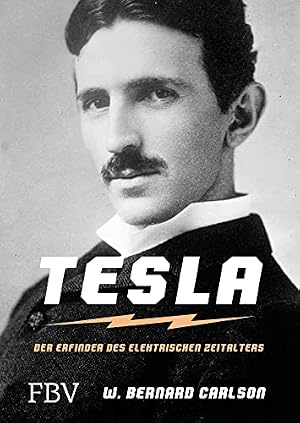
Tesla: Inventor of the Electrical Age
by W. Bernard Carlson
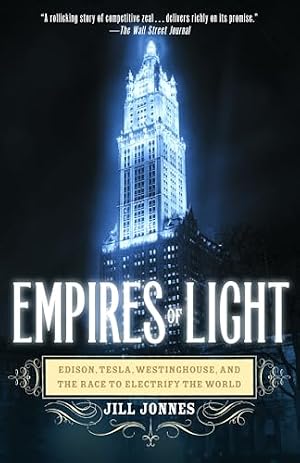
Empires of Light
by Jill Jonnes
As an Amazon Associate, TimelineSphere earns from qualifying purchases.
- The life and inventions of Nikola Tesla.
- The war of the currents between AC and DC.
- The harnessing of Niagara Falls.
- Tesla's wireless power dream and Wardenclyffe.
- Tesla's contributions to radio.
1856 born in Smiljan; 1870s studies engineering in Graz; 1884 emigrates to the U.S. and works briefly for Edison; 1887-1888 develops the rotating magnetic field and AC induction motor; 1888 Westinghouse licenses his patents; late 1880s-1890s the war of the currents; 1891 invents the Tesla coil and becomes a U.S. citizen; 1893 AC lights a world's fair; 1895 Niagara Falls hydroelectric project uses his designs; 1901-1906 the failed Wardenclyffe Tower; 1916 receives the Edison Medal; 1943 dies in New York, and a Supreme Court decision recognizes his radio patents.
- Choosing engineering over the priesthood.
- Emigrating to the United States in 1884.
- Patenting the AC induction motor in 1888.
- Westinghouse licensing his patents.
- Winning the war of the currents.
- The Niagara Falls power project.
- Inventing the Tesla coil.
- Launching the Wardenclyffe Tower project.
- The collapse of Wardenclyffe funding.
- The posthumous 1943 Supreme Court decision on radio.
- Tesla versus Edison: the bitter public battle over AC and DC power.
- Radio priority: long-running disputes over credit between Tesla and Marconi.
- Business dealings: debates over his financial decisions and lost fortunes.
- Late-life claims: some of his statements about future inventions remain unverified and disputed.
- AIEE Edison Medal (1916).
- Various national honors, including decorations from European states.
- Lasting scientific tribute: the SI unit of magnetic flux density, the tesla, is named after him.
Tesla is celebrated worldwide, with especially strong reverence in Serbia and Croatia and among engineers, scientists, and technology enthusiasts everywhere. His posthumous fame has made him a beloved icon of invention and imagination.
Tesla's alternating-current systems still power homes, industries, and cities around the world. His visionary work in wireless technology foreshadowed the connected world of today. His life remains an inspiring - and cautionary - story about genius, ambition, and recognition.
1. In what year was Nikola Tesla born?
2. What is Tesla best known for developing?
3. What did Tesla patent in 1888?
Did You Know: Nikola Tesla dreamed of sending electricity through the air without wires more than a century ago.
Imagine If: Imagine if J.P. Morgan had kept funding Wardenclyffe - Tesla's vision of wireless power might have advanced far sooner.
Historic Moment: In the 1890s, Tesla's alternating-current system harnessed Niagara Falls, proving AC could power the modern world.
On This Day: On 7 January 1943, Nikola Tesla died alone in a New York hotel, his greatest fame still ahead of him.
Nikola Tesla (1856-1943) was a Serbian-American inventor whose alternating-current system became the foundation of modern electric power, and who pioneered the Tesla coil and early wireless technology.
Born in the Austrian Empire, Tesla emigrated to America in 1884, briefly worked for Edison, and then developed the rotating magnetic field and AC induction motor. Backed by George Westinghouse, his alternating-current system won the war of the currents and powered Niagara Falls. He invented the Tesla coil and pursued wireless power at Wardenclyffe, a project that failed. He died in poverty in 1943 but became a celebrated icon of genius.
Nikola Tesla was born in 1856 in Smiljan, then in the Austrian Empire. After studying engineering in Graz, he emigrated to the United States in 1884 and briefly worked for Thomas Edison before striking out on his own. He discovered the rotating magnetic field and, in 1888, patented the first practical AC induction motor and a polyphase power system. George Westinghouse licensed his patents, and their alternating-current system defeated Edison's direct current in the war of the currents, famously lighting a world's fair and harnessing Niagara Falls. Tesla invented the Tesla coil in 1891 and pursued grand plans for wireless communication and power, culminating in the ill-fated Wardenclyffe Tower, which collapsed after financier J.P. Morgan withdrew support. Though he received the Edison Medal in 1916, Tesla struggled financially and died in relative poverty in 1943. That same year, a Supreme Court decision recognized his radio-related patents. His posthumous reputation soared, and the SI unit of magnetic flux density, the tesla, honors his name.
People searching "Nikola Tesla" typically want: a biography and timeline; what he invented; the story of AC versus Edison's DC; the Tesla coil and wireless power; how he died; his role in radio; and why he is celebrated today.
- 1.Encyclopaedia Britannica - "Nikola Tesla" (birth, AC system, rotating magnetic field, Westinghouse, immigration).
- 2.Tesla Science Center at Wardenclyffe - biographical details and the Wardenclyffe project.
- 3.The Franklin Institute - Tesla's arrival in America and work with Westinghouse.
- 4.The Henry Ford Museum - the 1888 induction motor and Westinghouse licensing.
- 5.HISTORY and the war of the currents references - the AC-versus-DC rivalry and 1943 radio patent decision.
Related timelines
How a patent clerk in Bern reimagined space, time, light and gravity - and became the most famous scientist who ever lived.
A poor girl from occupied Poland who became the first person in history to win two Nobel Prizes - and paid for her discoveries with her life.
From a five-year journey around the world to the theory of evolution by natural selection, this is the life of the naturalist who transformed biology forever.
The mathematician who imagined the modern computer, cracked Nazi codes, and was persecuted for who he was - only to be honored decades too late.
How a solitary genius uncovered the laws of motion and gravity, invented a new mathematics, and laid the foundations of modern science.
The global investment bank whose 2008 collapse shook the world economy.