APPLE INC.
The story of how two friends in a California garage built the brand that put computers, music, and the internet into everyone's pocket.
Started with a homemade circuit board in 1976, Apple became the first company worth a trillion dollars - and then kept climbing.

Apple Inc. is an American technology company founded in 1976 by Steve Jobs, Steve Wozniak, and Ronald Wayne. It helped launch the personal computer era with the Apple II and Macintosh, nearly collapsed in the 1990s, and then staged one of the greatest comebacks in business history with the iMac, iPod, iPhone, and iPad. In 2018 it became the first U.S. company to reach a one-trillion-dollar market value, and it has since grown into one of the most valuable companies ever.
Milestones
Apple Computer is founded by Jobs, Wozniak, and Wayne.
Apple releases the mass-market Apple II.
Apple holds its initial public offering.
Apple introduces graphical computers, including the Macintosh.
Steve Jobs leaves Apple after a power struggle.
Apple loses ground and nears bankruptcy.
Apple buys NeXT, and Jobs returns to lead the company.
Apple launches the colorful, all-in-one iMac.
Apple opens its first stores and launches the iPod.
Apple opens a legal digital music store.
Apple launches the iPhone and shortens its name to Apple Inc.
Apple launches the App Store.
- 1 April 1976The founding of Apple
Apple Computer is founded by Jobs, Wozniak, and Wayne.
- 1977The Apple II
Apple releases the mass-market Apple II.
- December 1980Apple goes public
Apple holds its initial public offering.
- 1983-1984Lisa and the Macintosh
Apple introduces graphical computers, including the Macintosh.
- 1985Jobs departs
Steve Jobs leaves Apple after a power struggle.
- 1990sDecline and crisis
Apple loses ground and nears bankruptcy.
- 1996-1997The return of Steve Jobs
Apple buys NeXT, and Jobs returns to lead the company.
- 1998The iMac
Apple launches the colorful, all-in-one iMac.
- 2001Retail stores and the iPod
Apple opens its first stores and launches the iPod.
- 2003The iTunes Store
Apple opens a legal digital music store.
- 2007The iPhone and a new name
Apple launches the iPhone and shortens its name to Apple Inc.
- 2008The App Store
Apple launches the App Store.
Explore this story
Few companies have shaped modern life as profoundly as Apple.
Born on April Fools' Day in 1976, Apple began as a partnership between the visionary Steve Jobs, the engineering genius Steve Wozniak, and a third co-founder, Ronald Wayne, who quickly left. Their goal was radical for the time: to make computers small, friendly, and personal.
The Apple II helped ignite the personal computer revolution, and the Macintosh brought the point-and-click interface to the masses. But success gave way to crisis. By the mid-1990s, after Jobs had been forced out, Apple was losing money and nearly failed.
Then came one of the most remarkable turnarounds in corporate history. Jobs returned, simplified the company, and launched a run of products - the iMac, iPod, iPhone, and iPad - that transformed multiple industries. Under later CEO Tim Cook, Apple became the first American company worth a trillion dollars. This is the story of that extraordinary rise.
- 1 April 1976The founding of Apple
Apple Computer is founded by Jobs, Wozniak, and Wayne.
On 1 April 1976, Steve Jobs, Steve Wozniak, and Ronald Wayne signed an agreement forming Apple Computer Company to sell Wozniak's Apple I computer. Wayne left the partnership shortly afterward.
It marked the birth of one of the most influential companies in history.
The founders assembled early machines in the Jobs family garage.
- 1977The Apple II
Apple releases the mass-market Apple II.
The Apple II, released in 1977, offered color graphics and ease of use, becoming one of the first hugely successful personal computers.
It helped launch the personal computing industry and established Apple as a leader.
The spreadsheet program VisiCalc helped drive Apple II sales to businesses.
- December 1980Apple goes public
Apple holds its initial public offering.
In December 1980 Apple went public, one of the most notable technology IPOs of its era, creating substantial wealth for its founders and early employees.
It signaled that personal computing had become a major industry.
The shares were offered at $22 each.
- 1983-1984Lisa and the Macintosh
Apple introduces graphical computers, including the Macintosh.
Apple released the Lisa in 1983 and the Macintosh in 1984. The Macintosh popularized the graphical user interface and mouse, and its "1984" commercial became legendary.
The Mac helped move computing toward the visual interfaces used today.
The Lisa was advanced but too expensive to succeed commercially.
- 1985Jobs departs
Steve Jobs leaves Apple after a power struggle.
In 1985, following internal conflict, Steve Jobs left Apple to found NeXT, and Wozniak also stepped back from active work at the company.
The loss of Jobs began a difficult period for Apple.
Jobs would not return for over a decade.
- 1990sDecline and crisis
Apple loses ground and nears bankruptcy.
During the 1990s, Apple lost significant market share to lower-priced computers running Windows and struggled to modernize its software. By 1997 it was reporting major losses.
The company's survival was genuinely in doubt.
Apple's troubles became a cautionary tale in the tech industry.
- 1996-1997The return of Steve Jobs
Apple buys NeXT, and Jobs returns to lead the company.
In late 1996 Apple acquired NeXT, bringing Steve Jobs back. In 1997 he took the helm of the struggling company, simplified its product line, and secured a headline investment from Microsoft.
It began Apple's historic turnaround.
NeXT's software became the foundation of Apple's modern operating systems.
- 1998The iMac
Apple launches the colorful, all-in-one iMac.
The iMac, released in 1998, was a striking all-in-one computer that became a commercial hit and signaled Apple's revival.
It restored Apple's reputation for design-driven products.
Its translucent, colorful design broke sharply from the beige boxes of the era.
Two Steves and a Garage
Apple began in 1976 when Steve Jobs and Steve Wozniak, joined briefly by Ronald Wayne, set out to sell Wozniak's Apple I computer. Their vision - to make computers personal and friendly - would soon reshape the world. The Apple II turned that vision into a booming business.
The Macintosh Era
Apple's 1980 public offering made its founders wealthy, and in 1984 the Macintosh brought the graphical interface to ordinary users. But internal conflict led Jobs to leave in 1985, beginning a slow decline.
The Wilderness Years
Through the 1990s, Apple lost ground to cheaper Windows PCs and struggled to modernize. By 1997 it was losing money and close to failure - one of the most dramatic falls in technology history.
The Comeback
Apple's purchase of NeXT brought Jobs back in 1997. He streamlined the company and launched the iMac in 1998. Then came the iPod, iTunes Store, and Apple's own retail stores, transforming Apple into a consumer electronics leader.
The iPhone Revolution
In 2007 the iPhone redefined the mobile phone, and the company renamed itself Apple Inc. The App Store in 2008 and the iPad in 2010 extended its reach, making Apple central to how billions of people live and work.
The Trillion-Dollar Giant
After Jobs's death in 2011, Tim Cook led Apple to unprecedented heights. In 2018 it became the first U.S. company worth a trillion dollars, and it kept growing. As Apple marked its 50th year, it stood among the most valuable companies the world has ever seen.
- Apple was founded on April Fools' Day, 1976.
- It began in a family garage.
- The Apple I was hand-built by Steve Wozniak.
- The Apple II helped launch the personal computer industry.
- Apple went public in 1980 at $22 a share.
- The Macintosh's "1984" ad is considered one of the greatest ever.
- Steve Jobs was forced out in 1985.
- Apple nearly went bankrupt in the 1990s.
- Co-founder Ronald Wayne sold his stake very early for a small sum.
- The company was first called Apple Computer, Inc.
- The Apple III, released in 1980, was a commercial disappointment.
- The PowerBook laptop line launched in the early 1990s.
- Apple's operating system woes were central to its 1990s crisis.
- NeXT's technology quietly powers Apple products to this day.
- Jobs initially returned with the title "interim CEO."
- Apple's "Think different" campaign accompanied its comeback.
Apple invented the personal computer.
It helped popularize personal computers but did not invent computing itself.
Apple invented the smartphone.
Smartphones existed before; the iPhone reinvented and popularized the modern touchscreen phone.
Apple was always hugely successful.
It nearly went bankrupt in the mid-1990s.
Steve Jobs founded Apple alone.
He co-founded it with Steve Wozniak and Ronald Wayne.
Apple invented the graphical user interface.
It popularized the interface for the mass market, building on earlier research.
The iPhone was an instant, universally praised success.
Many skeptics doubted it at launch; its dominance grew over time.
Apple's comeback was luck.
It resulted from strategic focus, design, and a series of hit products.
Apple only makes computers.
It makes phones, tablets, watches, audio devices, services, and more.
Tim Cook simply coasted on Jobs's legacy.
Under Cook, Apple's value grew enormously and it entered new product categories.
Apple's name always ended in "Inc."
It was "Apple Computer, Inc." until 2007.
Note: The following reflect widely reported statements associated with Apple and its leaders; meanings are summarized where wording varies.
Quote 1: Apple's founding vision was to make computers personal and accessible to ordinary people.
Meaning: The company's mission from the start was to bring technology into everyday life.
Quote 2: Apple's "Think different" campaign celebrated creativity and challenging the status quo.
Meaning: It framed Apple as a brand for innovators and rebels, central to its comeback identity.
Quote 3: Tim Cook has emphasized values such as privacy and responsibility alongside profit.
Meaning: Under Cook, Apple positioned itself around principles as well as products.
Apple's legacy is woven into modern life. It helped create the personal computer industry, brought the graphical interface to the masses, and reshaped music, phones, and mobile software. Its emphasis on design and integration set standards imitated across the technology world, and its rise from a garage to a trillion-dollar company is a defining business story of the modern era.
Apple influenced how technology looks, feels, and works. The iPhone reshaped communication, media, and photography; the App Store created a global software economy; and Apple's design philosophy influenced countless competitors. Its business practices and product strategies are studied worldwide.
- Did you know Apple was founded on April Fools' Day, 1976?
- Did you know it began in a family garage?
- Did you know a third co-founder left almost immediately?
- Did you know the Apple II helped launch personal computing?
- Did you know Apple went public in 1980?
- Did you know the Macintosh popularized the mouse?
- Did you know Steve Jobs was forced out in 1985?
- Did you know Apple nearly went bankrupt in the 1990s?
Apple vs Microsoft: Microsoft built its empire on software licensed to many manufacturers; Apple built tightly integrated hardware and software with a focus on design.
Apple vs Google: Apple emphasizes premium devices and privacy; Google built its business around search, advertising, and services.
Apple vs IBM: IBM long dominated business computing; Apple focused on making computers personal and consumer-friendly.
Apple vs Samsung: Both are smartphone leaders; Apple controls its full ecosystem, while Samsung is a broader electronics manufacturer.
- Technology
- Helped create the personal computer, smartphone, tablet, and app economies.
- Business
- Became a model of design-led strategy and one of the most valuable companies ever.
- Culture
- Its products changed how billions communicate, work, and consume media.
- Design
- Set global standards for minimalist, user-centered product design.
- Economy
- Generated enormous value and a vast ecosystem of developers and suppliers.
- Music & Media
- Reshaped the music and media industries through iTunes and apps.
- Society
- Made powerful computing a part of everyday life worldwide.
- Environment
- Increasingly emphasized recycling, materials, and energy commitments over time.
"Steve Jobs" by Walter Isaacson (covers Apple's founding and revival).
"Becoming Steve Jobs" by Brent Schlender and Rick Tetzeli.
"Tim Cook: The Genius Who Took Apple to the Next Level" by Leander Kahney.
"Infinite Loop" by Michael S. Malone (an Apple history).
"The One Device: The Secret History of the iPhone" by Brian Merchant.
- The founding and rise of Apple.
- The near-collapse and comeback of Apple in the 1990s.
- The making of the iPhone.
- Apple's design philosophy.
- Apple under Tim Cook.
1976 founded; 1977 Apple II; 1980 IPO; 1983-1984 Lisa and Macintosh; 1985 Jobs departs; 1990s decline; 1996-1997 NeXT acquisition and Jobs returns; 1998 iMac; 2001 retail stores and iPod; 2003 iTunes Store; 2007 iPhone and renaming to Apple Inc.; 2008 App Store; 2010 iPad; 2011 Tim Cook becomes CEO and Jobs dies; 2015-2016 Apple Watch and AirPods; 2018 first U.S. trillion-dollar company; 2020 surpasses two trillion dollars; 2026 50th anniversary and reported leadership transition.
- The founding in 1976.
- The success of the Apple II.
- The launch of the Macintosh.
- Steve Jobs's departure in 1985.
- The near-bankruptcy of the 1990s.
- The return of Jobs in 1997.
- The launch of the iPod.
- The launch of the iPhone in 2007.
- Tim Cook becoming CEO in 2011.
- Reaching a trillion-dollar valuation in 2018.
- Supplier conditions: Apple has faced scrutiny over labor conditions at overseas manufacturing partners.
- Market power: its control of the App Store and its fees have drawn antitrust and regulatory challenges.
- Repairability and environment: debates over device repairability and electronic waste.
- Innovation questions: critics have argued that some later products were more evolutionary than revolutionary.
- Consistently ranked among the world's most valuable and admired brands.
- Numerous design awards for its products over the decades.
- Industry recognition for innovation in personal computing and mobile devices.
Apple is one of the most recognized and popular brands in the world, with a vast, loyal customer base across the globe. Its product launches attract enormous attention, and its retail stores are landmarks in major cities.
Apple's products remain central to daily life for billions of people, and its ecosystem shapes the technology industry. As it marks 50 years and navigates a leadership transition, its decisions on privacy, artificial intelligence, and new device categories will influence the future of computing.
1. In what year was Apple founded?
2. Who were Apple's original founders?
3. Which early computer made Apple a leader?
Did You Know: Apple went from nearly bankrupt in 1997 to the first U.S. trillion-dollar company just two decades later.
Imagine If: Imagine if Apple had not bought NeXT - Steve Jobs might never have returned, and the iPhone might never have existed.
Historic Moment: In 2007, Apple unveiled the iPhone and renamed itself Apple Inc., signaling it was far more than a computer company.
On This Day: On 1 April 1976, Apple was founded - and turned out to be no April Fools' joke.
Short Summary: Apple Inc., founded in 1976, helped create the personal computer era, nearly collapsed in the 1990s, and then transformed technology with the iMac, iPod, iPhone, and iPad, becoming the first U.S. trillion-dollar company.
Medium Summary: Founded by Steve Jobs, Steve Wozniak, and Ronald Wayne, Apple rose with the Apple II and Macintosh before declining after Jobs left in 1985. His return in 1997 sparked a historic comeback built on the iMac, iPod, iTunes Store, iPhone, and iPad. Under Tim Cook, who became CEO in 2011, Apple became the first U.S. company worth a trillion dollars in 2018 and grew even larger.
Long Summary: Apple was founded on 1 April 1976 to sell Steve Wozniak's Apple I. The Apple II made it a leader in personal computing, and its 1980 IPO created substantial wealth. The 1984 Macintosh popularized the graphical interface, but Steve Jobs left in 1985 and the company declined through the 1990s, nearing bankruptcy by 1997. Apple's acquisition of NeXT brought Jobs back, and he led a turnaround with the iMac, iPod, iTunes Store, and Apple's own retail stores. The 2007 iPhone redefined the smartphone, the company renamed itself Apple Inc., and the App Store and iPad extended its reach. After Jobs resigned and died in 2011, Tim Cook led Apple to become the first U.S. trillion-dollar company in 2018 and to surpass two trillion in 2020. Apple marked its 50th anniversary in 2026 amid a reported leadership transition.
- 1.Encyclopaedia Britannica - "Apple Inc." (founding, products, headquarters).
- 2.U.S. Library of Congress - "The Founding of Apple Computer, Inc." (1 April 1976 founding by Jobs and Wozniak).
- 3.Wikipedia's sourced summary - product history and the 1990s crisis and comeback.
- 4.The Guardian - Apple becoming the first trillion-dollar U.S. company (2018).
- 5.CNBC, The New York Times, and Investopedia - Tim Cook's 2011 start, market-value growth, and 2026 reporting on a leadership transition.
Related timelines
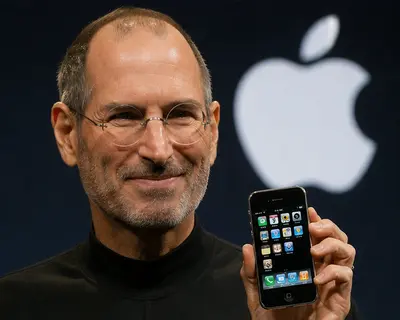
From a suburban California garage to the most valuable company on Earth - the relentless visionary who reinvented computers, phones, music, and animation.
"Big Blue" - the company that helped build the computing age.

From a lonely, bookish childhood in South Africa to leading the companies reshaping transport, energy, and space travel.

How two Stanford students in a rented garage built the company that became the front door to the internet.