STEVE JOBS
From a suburban California garage to the most valuable company on Earth - the relentless visionary who reinvented computers, phones, music, and animation.
He was fired from the company he founded, spent a decade in the wilderness, and then returned to build the most influential technology brand in history.
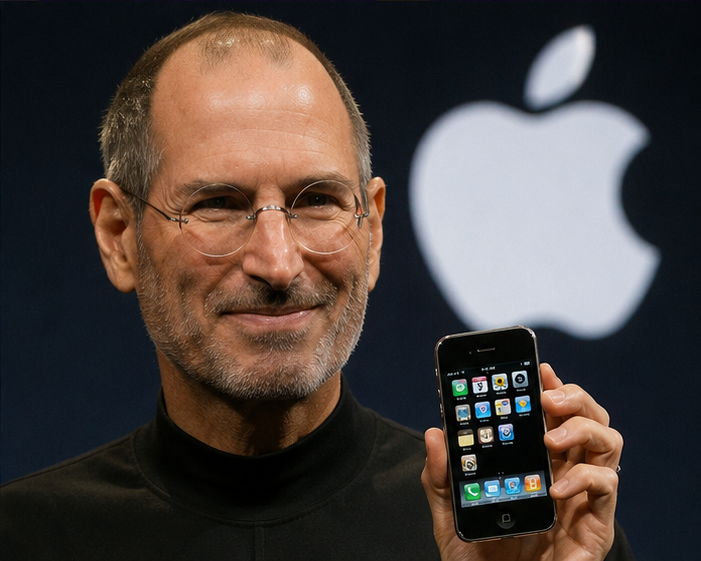
Steven Paul Jobs (1955-2011) was an American entrepreneur, inventor, and business leader who co-founded Apple in 1976. Forced out in 1985, he founded NeXT and transformed Pixar into an animation powerhouse before returning to a nearly bankrupt Apple in 1997. Over the next 14 years he led the launch of the iMac, iPod, iTunes Store, iPhone, and iPad, turning Apple into one of the world's most valuable companies and redefining entire industries.
Explore this story
Steve Jobs did not invent the computer, the phone, or the digital music player. What he did was more unusual: he made people fall in love with them.
An adopted child raised in what would become Silicon Valley, Jobs combined a fierce sense of design, an instinct for what people wanted before they knew it, and a famously demanding personality. With his friend Steve Wozniak, he started Apple in a family garage in 1976. By 25 he was a multimillionaire; by 30 he had been pushed out of his own company.
What followed is one of the great comeback stories in business history. Jobs spent his years away building NeXT and turning Pixar into the studio behind "Toy Story." When he returned to a struggling Apple in 1997, he rebuilt it around simplicity and beautiful design - and unleashed a decade of products that changed how the world listens to music, uses phones, and thinks about technology. This is the complete story of that journey.
- 24 February 1955Birth and adoption
Steven Paul Jobs is born in San Francisco and adopted by Paul and Clara Jobs.
Jobs was born on 24 February 1955 to biological parents Joanne Schieble and Abdulfattah Jandali, who placed him for adoption. He was raised by Paul and Clara Jobs, who later moved to the area south of San Francisco that became known as Silicon Valley.
Jobs grew up surrounded by the engineers and electronics culture that shaped his life's work.
His adoptive father, a machinist, taught him a love of careful craftsmanship that later showed in Apple's obsession with design.
- c. 1968-1969Meeting Steve Wozniak
A teenage Jobs meets the older electronics whiz Steve Wozniak.
As a young teenager, Jobs met Steve Wozniak, who was about five years older and a brilliant engineer. Their friendship would eventually produce Apple.
This partnership paired Wozniak's technical genius with Jobs's vision and drive.
Early on, the pair built and sold "blue boxes," devices that could make free long-distance phone calls.
- 1972-1974College, Atari, and a trip to India
Jobs drops out of Reed College, works at Atari, and travels to India.
Jobs enrolled at Reed College in Oregon but dropped out after about one semester, continuing to sit in on classes that interested him, such as calligraphy. He later took a job at the video game maker Atari and traveled to India in search of spiritual insight.
These experiences shaped his aesthetic sensibility and his lifelong interest in simplicity and design.
Jobs credited a calligraphy class at Reed with inspiring the beautiful typography later built into the Macintosh.
- 1 April 1976The founding of Apple
Jobs, Wozniak, and Ronald Wayne found Apple Computer.
Apple Computer Company was founded on 1 April 1976 by Steve Jobs, Steve Wozniak, and Ronald Wayne. Their first product, the Apple I, was a circuit board designed by Wozniak; the pair assembled early units in the Jobs family garage.
This marked the start of one of the most influential companies in history.
The Apple I was priced at $666.66, and co-founder Ronald Wayne sold his stake very early for a small sum.
- 5 June 1977The Apple II
Apple releases the Apple II, a landmark personal computer.
The Apple II, released in 1977, featured color graphics and came ready to use out of the box. It became one of the first highly successful mass-market personal computers.
The Apple II helped launch the personal computer industry and made Apple a major company.
The spreadsheet program VisiCalc, which ran on the Apple II, became a "killer app" that drove business sales.
- 12 December 1980Apple goes public
Apple's initial public offering makes Jobs a multimillionaire.
Apple went public in December 1980 in one of the largest technology IPOs of its era, instantly making Jobs extraordinarily wealthy while still in his mid-twenties.
The IPO signaled that personal computing had become a serious industry.
The offering reportedly pushed Jobs's net worth above $200 million at age 25.
- 1984The Macintosh
Apple launches the Macintosh, popularizing the graphical interface.
In 1984 Jobs oversaw the launch of the Macintosh, a computer that used a graphical user interface and a mouse, making computing far more accessible to ordinary people. Its "1984" television commercial became one of the most famous ads in history.
The Mac helped move computing away from text commands toward the visual interfaces we still use today.
The preceding Apple Lisa (1983) introduced similar ideas but was too expensive to succeed commercially.
- 1985Forced out of Apple
After a power struggle, Apple's board removes Jobs from his leadership role.
Following internal conflict and disappointing sales, Apple's board of directors stripped Jobs of his responsibilities in 1985. He resigned and left the company he had co-founded.
This humbling exit set the stage for one of business history's greatest comebacks.
Jobs later said that getting fired from Apple was one of the best things that ever happened to him, freeing him to enter his most creative period.
An Adopted Son of Silicon Valley
Steve Jobs was born in San Francisco in 1955 and adopted by Paul and Clara Jobs. Growing up in the area that would become Silicon Valley, he absorbed the culture of electronics hobbyists and engineers. His adoptive father's craftsmanship left a deep impression, planting the seed of Jobs's later obsession with making beautiful, well-made products.
The Garage and the Apple II
After dropping out of Reed College, working at Atari, and traveling to India, Jobs teamed with Steve Wozniak to found Apple in 1976. Wozniak's engineering brilliance and Jobs's vision and salesmanship proved a powerful combination. The Apple II turned the young company into a leader of the emerging personal computer industry, and Apple's 1980 IPO made Jobs a multimillionaire.
Triumph and Exile
In 1984 Jobs launched the Macintosh, bringing the graphical interface to the masses. But conflict with Apple's leadership led the board to strip him of power in 1985. Wounded but undeterred, Jobs founded NeXT and bought the graphics group that became Pixar. For a decade he built quietly, out of the spotlight.
The Comeback
When Apple acquired NeXT in 1996, Jobs returned. In 1997 he took the helm of a company near collapse and remade it - cutting products, sharpening focus, and betting everything on design. The colorful iMac in 1998 signaled that Apple was back.
The Golden Age
Between 2001 and 2010 Jobs led Apple through an astonishing run of products: the iPod, the iTunes Store, the iPhone, and the iPad. Each reshaped an industry. Apple grew into one of the most valuable companies on the planet, and Jobs became the world's most famous business leader.
Illness and Legacy
Diagnosed with cancer in 2003, Jobs continued to lead Apple through years of declining health, undergoing surgery and a liver transplant. He resigned as CEO in August 2011 and died that October. His legacy - products, a company, and a philosophy of design - continues to shape technology today.
- Jobs co-founded Apple at age 21 in his family's garage.
- Apple's first computer sold for $666.66.
- He was a multimillionaire by 25 after Apple's IPO.
- He was pushed out of Apple in 1985 - and returned to save it in 1997.
- He bought the company that became Pixar and funded it for years.
- Pixar's "Toy Story" was the first fully computer-animated feature film.
- The World Wide Web was created on a NeXT computer.
- He introduced the iPod, iPhone, and iPad - three category-defining products.
- Co-founder Ronald Wayne sold his Apple stake very early for a tiny sum.
- Jobs built and sold illegal "blue boxes" with Wozniak as a young man.
- He continued attending classes at Reed after officially dropping out.
- The expensive Apple Lisa preceded the Macintosh and largely failed commercially.
- NeXT's software (NeXTSTEP) became the basis of macOS and iOS.
- Jobs took only a symbolic $1 annual salary as Apple's CEO for years.
- He was a pescatarian and had strong, unusual dietary habits.
- He initially pursued alternative treatments before conventional cancer surgery.
Steve Jobs invented the personal computer.
He co-founded a company that popularized it; he did not invent computing itself.
Jobs was Apple's main engineer.
Steve Wozniak designed the early machines; Jobs led vision, design, and marketing.
Jobs invented the smartphone.
Smartphones existed before, but the iPhone reinvented and popularized the modern touchscreen phone.
Jobs never failed.
He was fired from Apple in 1985 and had product missteps; his career was defined by comeback.
Apple was always dominant.
Apple was near bankruptcy in the mid-1990s before Jobs's return.
Jobs did everything at Apple himself.
He led talented teams, including designer Jony Ive and many engineers.
Jobs invented computer animation.
Pixar's artists and engineers pioneered it; Jobs funded and championed the studio.
Jobs was formally trained in design or engineering.
He was largely self-taught and shaped by varied interests, including calligraphy.
The iPhone was an instant, obvious success to everyone.
Many skeptics doubted it at launch; its dominance grew over time.
Jobs cared only about technology.
He cared deeply about the intersection of technology with the humanities and art.
Note: Quotes below are widely documented from Jobs's speeches and interviews; where wording varies across sources, the meaning is summarized rather than presented as an exact transcript.
Quote 1: From his 2005 Stanford commencement address, Jobs urged graduates to "stay hungry, stay foolish."
Meaning: Keep learning, stay curious, and be willing to take risks rather than settling for the safe path.
Quote 2: In the same speech, he spoke about how you can only "connect the dots" looking backward, not forward.
Meaning: You cannot always see how experiences will matter later; you must trust that they will come together in time.
Quote 3: Jobs often argued that focus means saying no to a thousand good ideas.
Meaning: Great products come from ruthless prioritization, not from doing everything.
Steve Jobs's legacy lives on in Apple's products and design culture, in the smartphone-centered world the iPhone helped create, and in the standard he set for merging technology with art. He is remembered as a leader who insisted that products should be both powerful and beautiful, and who repeatedly bet on simplicity when the industry favored complexity.
Jobs influenced entrepreneurs, designers, and entire industries. The iPhone reshaped telecommunications, media, photography, and software. Pixar transformed animation. His emphasis on user experience and design became a template widely imitated across technology. His public presentations set a new standard for how companies launch products.
- Did you know Steve Jobs co-founded Apple in a family garage?
- Did you know Apple's first computer cost $666.66?
- Did you know Jobs was fired from Apple in 1985?
- Did you know he returned to Apple in 1997 and saved it?
- Did you know he owned most of Pixar?
- Did you know "Toy Story" was the first fully computer-animated feature film?
- Did you know the web was invented on a NeXT computer?
- Did you know a calligraphy class inspired Mac typography?
Steve Jobs vs Bill Gates: Gates built Microsoft around software that ran on many manufacturers' machines; Jobs built Apple around tightly integrated hardware and software with a focus on design.
Steve Jobs vs Steve Wozniak: Wozniak was the engineering genius behind Apple's early machines; Jobs was the visionary, marketer, and businessman.
Steve Jobs vs Elon Musk: Both are known for bold vision and demanding standards; Jobs focused on consumer technology and design, Musk on electric vehicles and space.
Steve Jobs vs Thomas Edison: Both were relentless promoters of innovation; Edison was a prolific inventor, while Jobs excelled at integrating and refining technologies into desirable products.
- Science & Technology
- Advanced personal computing, mobile technology, and digital media.
- Business
- Built Apple into one of the world's most valuable companies and reshaped multiple industries.
- Politics
- Less directly involved, though his companies influenced global trade and manufacturing debates.
- Culture
- The iPhone and iPod changed how billions communicate, work, and consume media.
- Education
- Apple products became widely used in schools and creative fields.
- Society
- Transformed daily habits around communication, photography, and information access.
- Environment
- His later products and Apple's direction increasingly emphasized design efficiency and, over time, environmental commitments by the company.
- Design
- Set a global benchmark for minimalist, user-centered product design.
Steve Jobs
by Walter Isaacson
Becoming Steve Jobs
by Brent Schlender and Rick Tetzeli
Creativity, Inc.
by Ed Catmull
The Innovators
by Walter Isaacson
As an Amazon Associate, TimelineSphere earns from qualifying purchases.
- The life and career of Steve Jobs.
- The founding and rise of Apple.
- The story of Pixar's breakthrough with "Toy Story."
- The making of the iPhone.
- Jobs's return and the turnaround of Apple.
1955 born and adopted; c. 1968-69 meets Wozniak; 1972-74 Reed College, Atari, India; 1976 founds Apple; 1977 Apple II; 1980 Apple IPO; 1984 Macintosh; 1985 forced out, founds NeXT; 1986 buys Pixar; 1995 "Toy Story"; 1997 returns to Apple; 1998 iMac; 2001 iPod; 2003 iTunes Store and cancer diagnosis; 2007 iPhone; 2010 iPad; August 2011 resigns as CEO; 5 October 2011 dies; 2022 posthumous Presidential Medal of Freedom.
- Meeting Steve Wozniak.
- Founding Apple in 1976.
- The success of the Apple II.
- The launch of the Macintosh in 1984.
- Being forced out of Apple in 1985.
- Acquiring Pixar in 1986.
- The success of "Toy Story" in 1995.
- Returning to Apple in 1997.
- The launch of the iPod in 2001.
- The launch of the iPhone in 2007.
- Management style: Jobs was often described as demanding and abrasive, and accounts of his treatment of colleagues remain debated.
- Health decisions: his initial choice to delay conventional cancer surgery in favor of alternative approaches has been widely discussed.
- Early credit and equity: the small payout to co-founder Ronald Wayne and disputes over early credit are recurring topics.
- Labor and manufacturing: Apple faced scrutiny over conditions at overseas suppliers during and after his tenure.
- Presidential Medal of Freedom (posthumous, 2022).
- National Medal of Technology (received earlier in his career, jointly recognized with Wozniak).
- Numerous industry honors during his lifetime.
Jobs is celebrated worldwide, especially in the United States and across the global technology and design communities. Apple's massive international customer base and Jobs's status as a cultural icon make him one of the most recognized business figures in history.
The devices and design philosophy Jobs championed still dominate daily life. Smartphones, app ecosystems, digital media stores, and the expectation that technology should be simple and beautiful all trace back in part to his work. His story also endures as a lesson in resilience, focus, and the power of vision.
1. In what year was Steve Jobs born?
2. Which company did Jobs co-found in 1976?
3. Who was Jobs's main co-founder and early engineer?
Did You Know: Steve Jobs was fired from the very company he founded - then came back and turned it into a global giant.
Imagine If: Imagine if Jobs had never returned to Apple in 1997 - the iPod, iPhone, and iPad might never have existed as we know them.
Historic Moment: In 2007, Jobs held up a single device and announced it was a phone, an iPod, and an internet communicator - the iPhone.
On This Day: On 5 October 2011, Steve Jobs died at age 56, prompting tributes around the world.
Steve Jobs (1955-2011) co-founded Apple, was forced out, returned in 1997, and led the creation of the iPod, iPhone, and iPad, becoming one of the most influential figures in technology.
Born in San Francisco and adopted, Steve Jobs co-founded Apple in 1976 with Steve Wozniak. After the Apple II and Macintosh, he was pushed out in 1985, founded NeXT, and built Pixar. Returning to a struggling Apple in 1997, he launched the iMac, iPod, iTunes Store, iPhone, and iPad, transforming multiple industries before his death in 2011.
Steve Jobs was born in 1955 and raised in what became Silicon Valley. After dropping out of Reed College, working at Atari, and traveling to India, he co-founded Apple with Steve Wozniak in 1976. The Apple II made the company a leader in personal computing, and the 1984 Macintosh brought the graphical interface to the masses. Ousted in 1985, Jobs founded NeXT and acquired Pixar, whose "Toy Story" (1995) revolutionized film. Apple bought NeXT in 1996, and Jobs returned in 1997 to rescue the company. Through the iMac, iPod, iTunes Store, iPhone, and iPad, he reshaped computing, music, and communication. Diagnosed with cancer in 2003, he led Apple through years of illness, resigned as CEO in August 2011, and died that October. He was posthumously awarded the Presidential Medal of Freedom in 2022.
People searching "Steve Jobs" usually want: a clear biography and timeline; why he was fired and how he returned; what he invented or launched; his role at Pixar; how he died; his famous quotes and speeches; and his lasting influence on Apple and technology.
- 1.Encyclopaedia Britannica - "Steve Jobs" biography (birth, death, cancer diagnosis, career milestones).
- 2.The Steve Jobs Archive (book.stevejobsarchive.com) - primary material on Apple's founding and Jobs's own words.
- 3.NPR - coverage and obituary material on Jobs's death and career.
- 4.CNET - detailed Steve Jobs and Apple product timeline.
- 5.U.S. National Library of Medicine / PMC - peer-reviewed article on the nature of Jobs's pancreatic (neuroendocrine) cancer.
- 6.Contemporary reporting on the 2022 posthumous Presidential Medal of Freedom.
Related timelines

The story of how two friends in a California garage built the brand that put computers, music, and the internet into everyone's pocket.

The story of vision and reinvention — from co-founding Microsoft and leading the personal-computing revolution to giving away a vast fortune through global philanthropy.

From a lonely, bookish childhood in South Africa to leading the companies reshaping transport, energy, and space travel.

The story of ambition and technology — from a Harvard dorm-room project to building the world's largest social network and betting on the metaverse.

The story of relentless ambition — from an online bookstore started in a garage to one of the world's largest companies, and from e-commerce to private spaceflight.

The engineer from Madurai who became CEO of Google and Alphabet.
You may also like