Salesforce, Inc.
The company that helped move business software to the cloud.
With a simple idea - that business software could run in a web browser instead of on your own computers - one company helped change how companies buy and use technology.
Salesforce, founded in 1999, pioneered delivering business software over the internet as a subscription service. Best known for cloud-based customer relationship management (CRM), it became a leader in enterprise software and a symbol of the shift to cloud computing.
Explore this story
For years, companies bought business software the hard way: installing it on their own servers and maintaining it themselves. Salesforce offered a different promise - just open a web browser.
By delivering powerful business tools over the internet, Salesforce helped popularize a new way of using software and became a leader in helping companies manage their customers.
This is the story of a company that helped move business into the cloud.
- 1999Salesforce is founded
Salesforce is founded, with Marc Benioff among its founders.
It aimed to deliver business software over the internet.
Began a pioneer of cloud-based software.
The idea challenged the traditional software model.
- Early 2000sSoftware as a service
Salesforce delivers CRM software through the web browser.
Customers subscribed instead of installing software themselves.
Helped popularize software as a service.
This model reduced the need for on-site servers.
- 2004Salesforce goes public
Salesforce holds its initial public offering.
It listed on the stock market under the ticker CRM.
Marked its rise as a public company.
Its ticker, CRM, reflects its core business.
- 2000s-2010sBuilding a platform
Salesforce expands from CRM into a broader software platform.
It offered tools for sales, service, and other business needs.
Broadened its role in enterprise software.
Developers could build applications on its platform.
- 2010sGrowth through acquisitions
Salesforce acquires many companies to expand its offerings.
Acquisitions added new products and capabilities.
Helped Salesforce grow rapidly.
Acquisition became central to its strategy.
- 2018Salesforce Tower
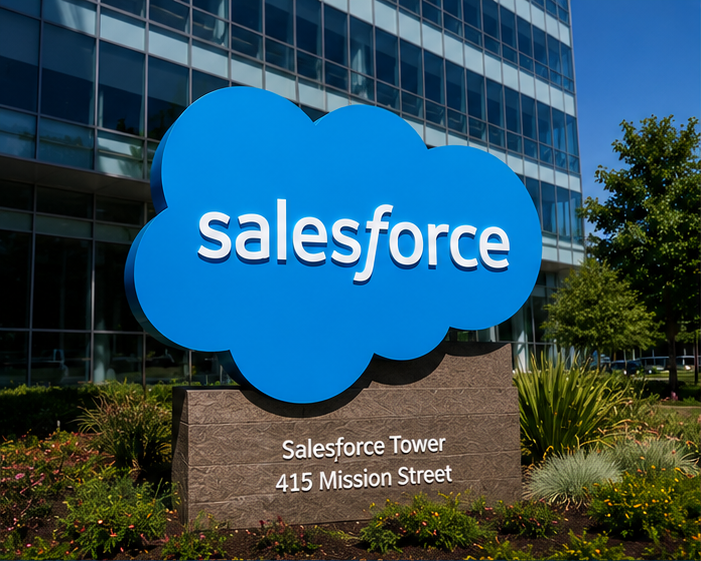
The Salesforce Tower becomes a landmark in San Francisco.
The skyscraper is associated with the company's headquarters.
Symbolized Salesforce's prominence.
It is one of San Francisco's tallest buildings.
- 2010s-2020sA cloud-software leader
Salesforce becomes a leading enterprise-software company.
Its cloud platform serves businesses worldwide.
Cemented its role in the cloud era.
It is a symbol of the shift to cloud computing.
A New Idea for Software
Salesforce was founded in 1999, with Marc Benioff among its founders, on a bold idea: business software could be delivered over the internet rather than installed on a company's own computers. This directly challenged the traditional software model.
Software as a Service
In the early 2000s, Salesforce delivered its customer relationship management (CRM) software through the web browser. Customers subscribed to the service instead of buying and installing software, helping popularize what became known as software as a service (SaaS) and reducing the need for on-site servers.
Going Public
Salesforce went public in 2004, listing under the ticker CRM - a nod to its core business. The milestone marked its rise as a significant public company in enterprise software.
From Product to Platform
Through the 2000s and 2010s, Salesforce expanded from CRM into a broader software platform, offering tools for sales, service, and other business functions, and allowing developers to build applications on top of it.
Growth by Acquisition
During the 2010s, Salesforce acquired many companies, adding new products and capabilities. Acquisition became central to its strategy and fueled rapid growth.
A Cloud Landmark
By the late 2010s and 2020s, Salesforce had become a leading enterprise-software company and a symbol of the shift to cloud computing. The Salesforce Tower, one of San Francisco's tallest buildings, came to symbolize the company's prominence.
- Salesforce was founded in 1999.
- Marc Benioff was a co-founder.
- It aimed to deliver software over the internet.
- It challenged the traditional software model.
- It is known for cloud-based CRM.
- CRM means customer relationship management.
- It helped popularize software as a service.
- Customers subscribed instead of installing.
- Salesforce was founded in 1999.
- Marc Benioff was among its founders.
- It delivered software over the internet early on.
- It challenged the install-it-yourself model.
- It helped popularize software as a service.
- It went public in 2004.
- Its ticker is CRM.
- It expanded from CRM into a platform.
Salesforce only makes one product.
It offers a broad platform of business applications.
Salesforce sells software you install yourself.
It pioneered delivering software over the internet.
Salesforce was founded in the 2010s.
It was founded in 1999.
CRM stands for something unrelated.
CRM means customer relationship management.
Salesforce is a consumer app company.
It mainly serves businesses.
Salesforce grew only through its own products.
Acquisitions were central to its growth.
Software as a service was Salesforce's invention alone.
It helped popularize SaaS, part of a broader industry shift.
The Salesforce Tower is unrelated to the company.
It is associated with the company's San Francisco headquarters.
Salesforce is a small firm.
It is a leading enterprise-software company.
Salesforce did not affect how software is bought.
Its subscription model changed software purchasing.
Note: To respect strict accuracy, verbatim quotations are omitted here because exact wording cannot be verified in this draft. Salesforce's story is closely associated with themes of cloud computing, subscription software, and challenging the traditional software model.
Salesforce's legacy is helping move business software to the cloud. By delivering CRM over the internet as a subscription, it popularized software as a service and reshaped how companies buy and use technology - becoming a symbol of the cloud era.
Salesforce influenced the entire software industry by demonstrating that powerful business tools could be delivered over the internet. Its subscription model became widespread, and its platform enabled a large ecosystem of business applications and developers.
- Did you know Salesforce was founded in 1999?
- Did you know Marc Benioff co-founded it?
- Did you know it delivers software over the internet?
- Did you know it challenged the traditional software model?
- Did you know it is known for cloud CRM?
- Did you know CRM means customer relationship management?
- Did you know it helped popularize SaaS?
- Did you know customers subscribe rather than install?
Compared with traditional software companies that sold installed programs, Salesforce pioneered delivering software over the internet by subscription. Compared with older enterprise-software firms like Oracle, Salesforce was born in the cloud era and helped define the software-as-a-service model.
- Science
- Not a primary focus of its work.
- Technology
- It helped popularize cloud-based software.
- Business
- It transformed how companies buy and use software.
- Politics
- Not a primary focus of its work.
- Culture
- It influenced the culture of the cloud-software industry.
- Education
- Its model is widely studied in business and tech.
- Society
- It changed everyday business technology.
- Environment
- Cloud data centers raised energy-use considerations.
- General books on cloud computing and SaaS.
- Books on the enterprise-software industry.
- Works on Silicon Valley business.
- Documentary topics on the rise of cloud computing.
- Features on the software industry.
- Programs on modern business technology.
Founded (1999); delivered browser-based CRM (early 2000s); IPO under ticker CRM (2004); expanded into a platform (2000s-2010s); grew through acquisitions (2010s); Salesforce Tower landmark (2018); became a leading cloud-software company (2010s-2020s).
- Founding in 1999.
- Delivering software over the internet.
- Popularizing software as a service.
- Going public (2004).
- Expanding from CRM to a platform.
- Opening the platform to developers.
- Growing through acquisitions.
- Becoming a cloud-software leader.
- The Salesforce Tower landmark (2018).
- Symbolizing the cloud era.
As a major technology company, Salesforce has been part of public debate over industry and business matters. This article notes these areas neutrally and omits disputed or unverified specifics.
Note: To avoid citing unverified specifics, this section notes general recognition. Salesforce and its leadership are widely recognized in technology and business.
Salesforce is widely used by businesses worldwide. Though less visible to everyday consumers, it is a dominant name in enterprise and cloud software.
In 2026, Salesforce remains a leading enterprise-software company and a symbol of the cloud era it helped create. Its platform continues to shape how businesses manage customers and operations.
1. When was Salesforce founded?
2. Who co-founded Salesforce?
3. What does CRM stand for?
Did You Know: Salesforce's stock ticker is literally CRM. Imagine If: Business software runs in a browser, not on your servers - Salesforce made that mainstream. Historic Moment: 2004, when Salesforce went public. On This Day: 1999 - Salesforce is founded.
Short Summary: Salesforce is the cloud-software company that popularized subscription-based business applications and CRM.
Medium Summary: Founded in 1999 with Marc Benioff among its founders, Salesforce pioneered delivering CRM software over the internet as a subscription, went public in 2004 under the ticker CRM, expanded into a broad cloud platform, and became a leader in enterprise software and a symbol of the cloud era.
Long Summary: Salesforce was founded in 1999, with Marc Benioff among its founders, on the idea that business software could be delivered over the internet rather than installed on a company's own computers. In the early 2000s it delivered customer relationship management (CRM) software through the web browser on a subscription basis, helping popularize software as a service and reducing the need for on-site servers. It went public in 2004 under the ticker CRM, then expanded from CRM into a broad platform for sales, service, and other business needs, opening it to developers. Through the 2010s it grew rapidly via acquisitions, and by the late 2010s and 2020s it had become a leading enterprise-software company and a symbol of the shift to cloud computing, with the Salesforce Tower standing as a landmark of its prominence.
People searching for Salesforce usually want its founding story, what CRM and SaaS are, the role of Marc Benioff, and how it helped move business software to the cloud.
- 1.Official Salesforce corporate and history pages
- 2.Salesforce annual reports (Form 10-K) and SEC filings
- 3.Encyclopaedia Britannica (company entry)
- 4.Reputable major news organizations for recent events
Related timelines

The database giant that helped run the world's businesses.
From a two-person startup in Albuquerque to a multi-trillion-dollar cloud and AI powerhouse, this is the story of the company that taught the world to compute.

The social-media giant behind Facebook, Instagram, and WhatsApp.

The graphics-chip maker that became the engine of the AI revolution.

The platform that helped make music streaming mainstream.

The platform that let the world broadcast itself.