Blockbuster — How a 9,000-Store Empire Vanished in the Age of Streaming
The story of the video-rental giant that once ruled Friday nights, turned down a chance to buy Netflix, and collapsed as the world went digital.
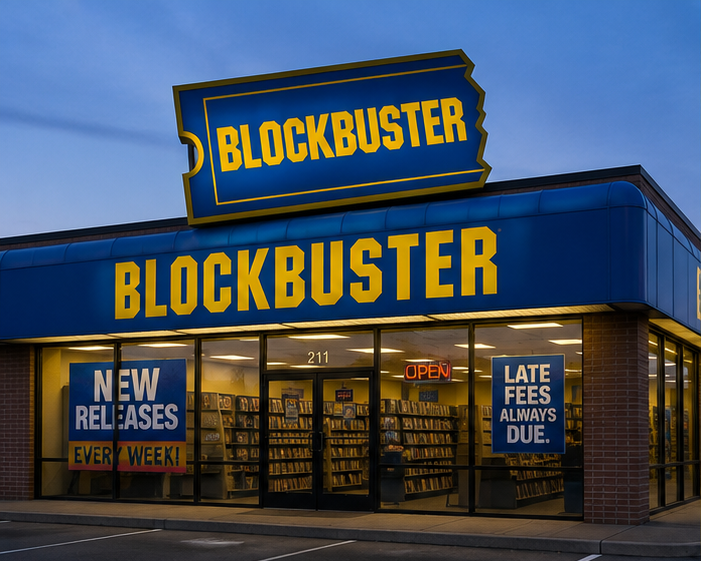
For a generation, the ritual was sacred: walk the aisles, feel the plastic cases, argue over a movie, and dread the late fee. Blockbuster was the beating heart of home entertainment — until technology it underestimated swept it away. This is the complete, verified timeline of Blockbuster's rise to dominance and its dramatic fall.
Milestones
David Cook launches a video store in Dallas.
Blockbuster scales up quickly.
Blockbuster becomes an international giant.
A fateful decision not to buy Netflix.
Blockbuster reaches its zenith.
Blockbuster's belated online push.
The empire files for Chapter 11.
The chain winds down.
One store remains.
- 1985The First Blockbuster Store Opens
David Cook launches a video store in Dallas.
- Late 1980sRapid Expansion Begins
Blockbuster scales up quickly.
- 1990sGlobal Expansion and Dominance
Blockbuster becomes an international giant.
- 2000The Netflix Offer Blockbuster Declined
A fateful decision not to buy Netflix.
- December 2004Peak — and a Hostile Takeover Attempt
Blockbuster reaches its zenith.
- 2007Total Access Fights Back
Blockbuster's belated online push.
- 2010Bankruptcy
The empire files for Chapter 11.
- By 2014Corporate Stores Close
The chain winds down.
- 2019 onwardThe Last Blockbuster
One store remains.
Explore this story
Blockbuster is one of the most instructive business stories of the modern era — a cautionary tale about disruption, complacency, and the speed at which technology can topple even a dominant giant.
Founded in 1985 as a single video-rental store, Blockbuster grew explosively through the 1990s into a global chain. At its 2004 peak it operated more than 9,000 stores and employed over 84,000 people worldwide. It was, for many, synonymous with renting movies.
Yet within a few short years, Blockbuster went from empire to afterthought. The rise of mail-order and then streaming — led by Netflix — combined with the burden of thousands of physical stores and a business model dependent on late fees, proved fatal. Blockbuster filed for bankruptcy in 2010.
This timeline traces Blockbuster's journey from its founding to its collapse, and the strange afterlife of a brand that today survives in a single nostalgic store. Every major date and figure has been cross-checked against authoritative reporting and case studies.
- 1985The First Blockbuster Store Opens
David Cook launches a video store in Dallas.
In 1985, David Cook opened the first Blockbuster video-rental store in Dallas, Texas. Its advantage was a large selection of titles compared with the small, dimly lit video stores common at the time.
The beginning of what would become the world's largest video-rental chain.
The first store reportedly stocked thousands of VHS tapes — far more than typical competitors.
- Late 1980sRapid Expansion Begins
Blockbuster scales up quickly.
Blockbuster grew from a single shop into a public store chain, expanding aggressively and building brand recognition through its large-format stores and wide selection.
Established Blockbuster as a national player in home entertainment.
Entrepreneur Wayne Huizenga became instrumental in scaling Blockbuster into a major empire.
- 1990sGlobal Expansion and Dominance
Blockbuster becomes an international giant.
Throughout the 1990s, Blockbuster expanded internationally, opening stores worldwide and becoming synonymous with renting movies. It added video-game rentals and diversified its offerings.
Blockbuster reached the height of its cultural influence, dominating home movie rentals.
For many families, a trip to Blockbuster was a weekend ritual.
- 2000The Netflix Offer Blockbuster Declined
A fateful decision not to buy Netflix.
In 2000, Netflix — then a mail-order DVD rental startup — offered to sell itself to Blockbuster for about $50 million. Blockbuster's leadership declined. Netflix co-founder Marc Randolph later recounted that Blockbuster executives essentially laughed the proposal off.
Widely regarded as one of the most consequential missed opportunities in business history.
Netflix would go on to become a dominant global entertainment company.
- December 2004Peak — and a Hostile Takeover Attempt
Blockbuster reaches its zenith.
At its 2004 peak, Blockbuster operated more than 9,000 stores worldwide and employed over 84,000 people. In December 2004, it announced an attempt to acquire rival Hollywood Video, though the effort was later withdrawn amid regulatory opposition.
Marked the high-water mark before the decline.
Hollywood Video was ultimately bought by a smaller competitor, Movie Gallery, which itself later failed.
- 2007Total Access Fights Back
Blockbuster's belated online push.
In 2007, Blockbuster launched Total Access, letting customers rent DVDs online and exchange them in stores. It initially attracted around 2 million subscribers in its first year — but the program was costly and financially unsustainable, reportedly losing money on each disc rented.
Showed Blockbuster could innovate, but too late and at too high a cost.
Blockbuster's huge physical footprint became a liability rather than an advantage.
- 2010Bankruptcy
The empire files for Chapter 11.
Weighed down by debt, thousands of stores, and the accelerating shift to streaming and kiosks, Blockbuster filed for Chapter 11 bankruptcy in 2010.
The formal collapse of a company that had dominated its industry.
The bankruptcy became a defining symbol of digital disruption.
- By 2014Corporate Stores Close
The chain winds down.
Blockbuster closed its remaining corporate-owned stores by 2014. A small number of franchise locations continued for a time. Dish Network came to own the Blockbuster trademark.
Ended Blockbuster as a functioning national chain.
A handful of franchise stores outlasted the corporate closures.
- 2019 onwardThe Last Blockbuster
One store remains.
After other locations closed, the store in Bend, Oregon became the last Blockbuster in the world. It survives largely on merchandise sales and tourism, licensing the Blockbuster name.
A nostalgic survivor and cultural landmark.
A 2020 documentary, "The Last Blockbuster," chronicled the store and its manager.
— The Big Idea (1985)
David Cook opened a video store with a simple but powerful edge: a huge selection. Where competitors offered a few hundred titles in cramped shops, Blockbuster offered thousands in bright, family-friendly stores. Customers loved the choice.
— The Empire (late 1980s–1990s)
With aggressive expansion — and the business acumen of figures like Wayne Huizenga — Blockbuster spread across the United States and then the world. It became a cultural institution, the default destination for movie night, and a dominant force in home entertainment.
— The Missed Future (2000–2007)
When Netflix offered to sell itself for about $50 million in 2000, Blockbuster declined. As Netflix's mail-order model and the coming wave of streaming gathered momentum, Blockbuster's late-fee-dependent, store-heavy model looked increasingly outdated. Its Total Access counterattack in 2007 was innovative but arrived too late and cost too much.
— The Fall (2010–present)
Burdened by debt and thousands of stores, Blockbuster filed for bankruptcy in 2010 and closed its corporate stores by 2014. Today, a single nostalgic store in Bend, Oregon keeps the brand alive — a monument to how quickly disruption can rewrite an industry.
- Blockbuster started as a single store in Dallas in 1985.
- Its early edge was offering thousands of titles when rivals had hundreds.
- At its peak it had more than 9,000 stores worldwide.
- It employed over 84,000 people at its height.
- Blockbuster could have bought Netflix for about $50 million — and said no.
- Netflix's founders reportedly were laughed out of the room.
- Blockbuster expanded to many countries in the 1990s.
- It tried to take over rival Hollywood Video in 2004.
- The first Blockbuster reportedly stocked around 8,000 VHS tapes.
- Blockbuster's peak store count was around 9,094 locations.
- The company's 2004 workforce numbered roughly 84,300 worldwide.
- Netflix's offer to sell to Blockbuster was around $50 million in 2000.
- Total Access launched in 2007, well into the streaming shift.
- Blockbuster withdrew its Hollywood Video takeover bid amid regulatory opposition.
- Hollywood Video was acquired by the smaller Movie Gallery in 2005.
- The last store in Bend opened in 1992 as an independent video store before becoming a Blockbuster franchise.
Blockbuster never had a chance against Netflix
It was offered the chance to buy Netflix around 2000 and declined.
Blockbuster never tried to go digital
It launched Total Access in 2007.
Blockbuster failed overnight
Its decline unfolded over several years after its 2004 peak.
All Blockbuster stores are gone
One store in Bend, Oregon still operates.
Blockbuster was always a giant
It began as a single store in 1985.
Late fees were minor
They were a significant and controversial part of its model.
Blockbuster only rented movies
It also rented video games.
Streaming alone killed Blockbuster
Debt, store costs, and strategic missteps also played major roles.
The last store is a corporate location
It is a franchise that licenses the brand name.
Blockbuster's competitors all thrived
Rivals like Movie Gallery also collapsed.
Note: Only responsibly attributable statements are included; where exact wording is uncertain, the idea is paraphrased.
Netflix co-founder Marc Randolph has recounted that Blockbuster's leadership dismissed Netflix's offer to be acquired — an account widely cited in business histories.
Business analysts frequently summarize Blockbuster's lesson as the danger of ignoring disruptive competitors while dominant.
(Specific verbatim quotations have been omitted where exact wording could not be verified against authoritative sources.)
Blockbuster's legacy is twofold. Culturally, it represents a beloved era of home entertainment — the browsing, the choosing, the shared family ritual of movie night. Strategically, it stands as one of the defining case studies in how established companies can be disrupted by new technology and business models. Its name is now shorthand for failing to adapt.
Blockbuster shaped how a generation consumed movies at home and helped popularize the large-format rental store. Its fall influenced how businesses think about disruption, agility, and the risks of complacency. The contrast between Blockbuster and Netflix is taught worldwide as a lesson in innovation and adaptation.
- Did you know Blockbuster started as one store in Dallas in 1985?
- Did you know it once had more than 9,000 stores?
- Did you know it employed over 84,000 people at its peak?
- Did you know Blockbuster could have bought Netflix for about $50 million?
- Did you know it declined that offer around 2000?
- Did you know Blockbuster tried to buy Hollywood Video in 2004?
- Did you know it launched Total Access in 2007?
- Did you know Total Access reportedly lost money on each disc?
Blockbuster vs. Netflix: Netflix embraced mail-order then streaming and a subscription model without late fees; Blockbuster relied on physical stores and late fees, adapting too late. Blockbuster vs. Redbox: Redbox used low-cost automated kiosks; Blockbuster carried the overhead of large staffed stores. Blockbuster vs. Hollywood Video: Both were major rental chains; both ultimately failed as the market shifted. Early Blockbuster vs. Late Blockbuster: The early company thrived on selection and expansion; the late company struggled under debt, store costs, and digital competition.
Blockbuster's rise and fall marks a pivotal moment in the transition from physical to digital media. Its dominance defined home entertainment for years, and its collapse signaled the arrival of the streaming age. The company's story reshaped how businesses and scholars think about innovation, disruption, and the fatal risks of standing still.
"That Will Never Work" by Marc Randolph (Netflix co-founder; covers the Blockbuster offer).
"Netflixed: The Epic Battle for America's Eyeballs" by Gina Keating.
Business case studies on Blockbuster's bankruptcy (e.g., academic Chapter 11 case studies).
"The Innovator's Dilemma" by Clayton Christensen (on disruption theory relevant to Blockbuster's fall).
- "The Last Blockbuster" (2020) — documentary about the final store and its manager.
- Various business and tech documentaries examining the Netflix–Blockbuster story. (Additional titles omitted where accurate details could not be verified.)
1985 first store → late 1980s rapid expansion → 1990s global dominance → 2000 declines Netflix offer → 2004 peak (9,000+ stores) and Hollywood Video bid → 2007 Total Access → 2010 bankruptcy → 2014 corporate stores closed → 2019 Bend becomes last store → 2020 documentary.
- The 1985 founding with a large-selection model.
- Aggressive expansion into a national and global chain.
- The 2000 decision to decline buying Netflix.
- The 2004 peak and the Hollywood Video takeover attempt.
- The rise of Netflix's mail-order and streaming models.
- The 2007 launch of Total Access.
- The unsustainable economics of Total Access.
- The 2010 bankruptcy filing.
- The 2014 closure of corporate stores.
- The survival of a single store in Bend, Oregon.
Blockbuster faced customer frustration over late fees, which were a significant part of its revenue model and a frequent source of complaints. Its business decisions — particularly declining to acquire Netflix and its slow response to digital competition — have been widely criticized in hindsight. Its attempted takeover of Hollywood Video drew regulatory opposition. These are presented as documented business history.
At its height, Blockbuster was one of the most recognized brands in home entertainment and a dominant retail chain. While it is better remembered today for its cautionary business story than for formal awards, its brand recognition remains iconic, and the last store has become a celebrated cultural landmark. (Specific corporate awards are not emphasized here where details could not be verified.)
Blockbuster remains a powerful nostalgic brand. Its blue-and-yellow logo evokes strong memories for those who grew up renting movies. The last store in Bend, Oregon attracts visitors from around the world, and Blockbuster references appear regularly in popular culture and discussions of business history.
As of 2026, Blockbuster matters as one of the clearest lessons in modern business: even a dominant company can vanish if it fails to adapt to technological change. In an era of rapid disruption — from streaming to artificial intelligence — Blockbuster's story is a constant reminder that market leadership is never permanent. Its nostalgic afterlife also speaks to the enduring emotional power of shared cultural rituals.
1. In what year was Blockbuster founded?
2. Who founded Blockbuster?
3. Where was the first Blockbuster store?
- 1985: First store opens in Dallas.
- 1990s: Global dominance.
- 2000: Declines to buy Netflix.
- 2004: Peak with 9,000+ stores.
- 2007: Total Access launches.
- 2010: Bankruptcy.
- 2019: Bend becomes the last store worldwide.
SHORT SUMMARY: Blockbuster, founded in 1985, grew into a 9,000-store video-rental empire before collapsing in 2010, undone by streaming, debt, and its own failure to adapt — famously passing on a chance to buy Netflix.
MEDIUM SUMMARY: Starting as a single Dallas store in 1985, Blockbuster rode a large-selection model to global dominance in the 1990s. At its 2004 peak it had more than 9,000 stores and over 84,000 employees. But it declined to buy Netflix around 2000, leaned on late fees, and responded too slowly to streaming. Its 2007 Total Access service was innovative but unprofitable. Blockbuster filed for bankruptcy in 2010, closed corporate stores by 2014, and now survives only as a single nostalgic store in Bend, Oregon.
LONG SUMMARY: Blockbuster's arc is a defining business story of the digital age. Founded by David Cook in 1985 in Dallas, it disrupted small local video stores by offering thousands of titles in bright, family-friendly locations. Through aggressive expansion — aided by entrepreneur Wayne Huizenga — it became a global powerhouse in the 1990s and the cultural home of movie night. At its 2004 peak, it operated more than 9,000 stores worldwide and employed over 84,000 people, even attempting to take over rival Hollywood Video. But the seeds of its downfall were already planted: around 2000, Blockbuster declined to buy the fledgling Netflix for about $50 million. As Netflix's mail-order and streaming models grew, and as kiosks like Redbox spread, Blockbuster's store-heavy, late-fee-dependent model faltered. Its 2007 Total Access counterattack drew millions of subscribers but lost money on each disc. Weighed down by debt and thousands of stores, Blockbuster filed for Chapter 11 bankruptcy in 2010 and shut its corporate stores by 2014. Today, a single franchise store in Bend, Oregon — the last Blockbuster in the world — survives on merchandise and tourism, immortalized in the 2020 documentary "The Last Blockbuster," and the brand endures as the ultimate symbol of disruption.
- 1.Britannica and encyclopedic reference entries on Blockbuster's founding, peak, and decline.
- 2.Cato Institute — "Lessons from the Rise of Netflix and the Fall of Blockbuster" (details the ~$50 million Netflix offer).
- 3.Variety — reporting on Netflix's history and the Blockbuster Total Access story.
- 4.University of Tennessee College of Law — "A Blockbuster Failure" Chapter 11 bankruptcy case study.
- 5."The Last Blockbuster" (2020) documentary and coverage of the Bend, Oregon store.
- 6.Contemporary business reporting on Blockbuster's 2004 peak (9,000+ stores, ~84,300 employees) and 2004 Hollywood Video takeover attempt.
Related timelines

The DVD-by-mail company that became the world's streaming leader.

The membership warehouse retail giant.
The computer giant that helped popularize IBM-compatible PCs.

The story of media savvy, entrepreneurship, and reinvention — from "Keeping Up with the Kardashians" to the shapewear empire SKIMS and a growing legal career.
The online bookstore that grew into a global commerce and cloud empire.
A pioneer of online auctions and marketplaces.